
Plus get our latest book recommendations, author news, and competitions right to your inbox.
Table of Contents
About The Book
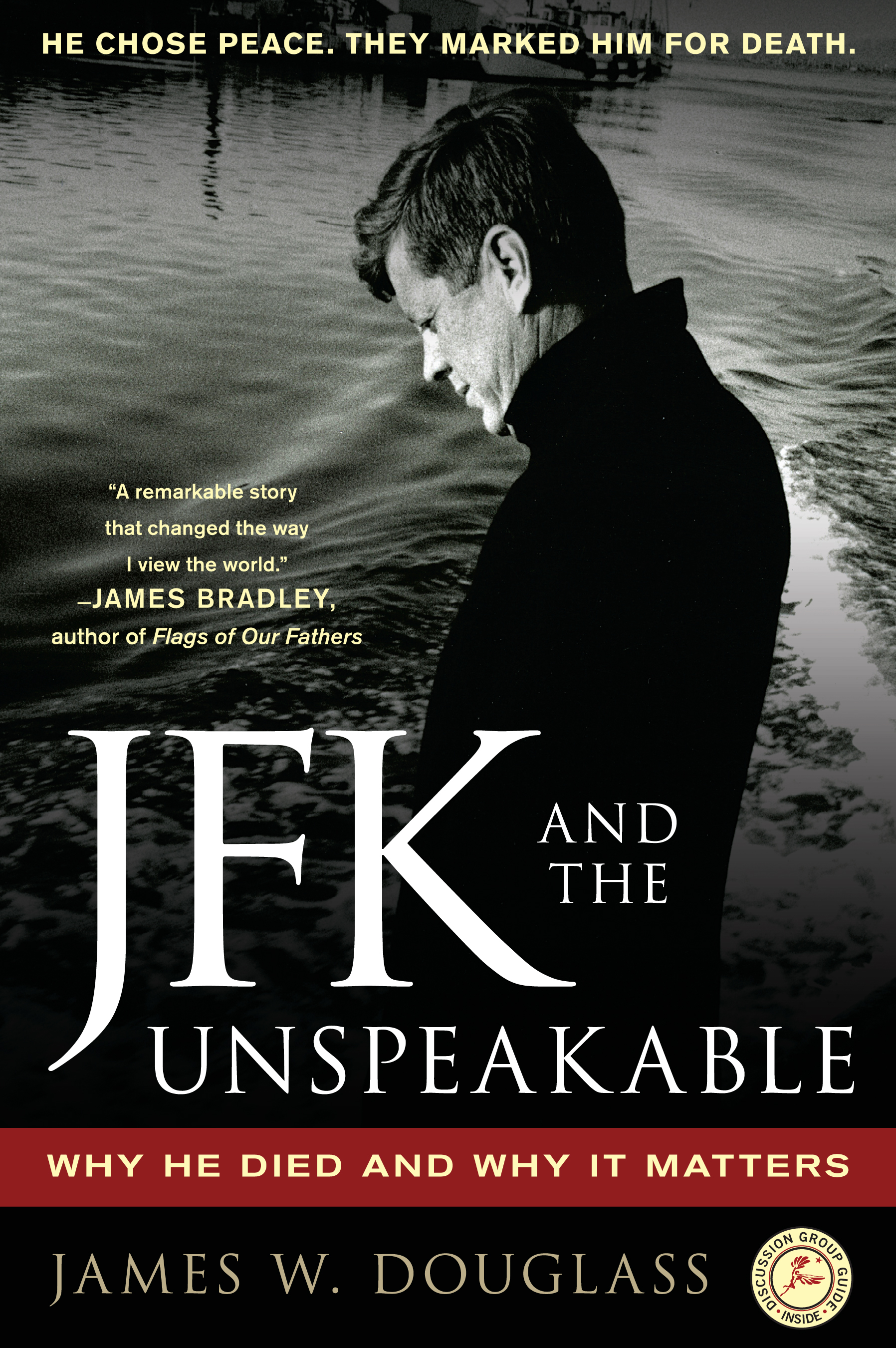
The acclaimed book Oliver Stone called “the best account I have read of this tragedy and its significance,” JFK and the Unspeakable details not just how the conspiracy to assassinate President John F. Kennedy was carried out, but WHY it was done…and why it still matters today.
At the height of the Cold War, JFK risked committing the greatest crime in human history: starting a nuclear war. Horrified by the specter of nuclear annihilation, Kennedy gradually turned away from his long-held Cold Warrior beliefs and toward a policy of lasting peace. But to the military and intelligence agencies in the United States, who were committed to winning the Cold War at any cost, Kennedy’s change of heart was a direct threat to their power and influence. Once these dark “Unspeakable” forces recognized that Kennedy’s interests were in direct opposition to their own, they tagged him as a dangerous traitor, plotted his assassination, and orchestrated the subsequent cover-up.
Douglass takes readers into the Oval Office during the tense days of the Cuban Missile Crisis, along on the strange journey of Lee Harvey Oswald and his shadowy handlers, and to the winding road in Dallas where an ambush awaited the President’s motorcade. As Douglass convincingly documents, at every step along the way these forces of the Unspeakable were present, moving people like pawns on a chessboard to promote a dangerous and deadly agenda.
JFK and the Unspeakable shot up to the top of the bestseller charts when Oliver Stone first brought it to the world’s attention on Bill Maher’s show. Since then, it has been lauded by Mark Lane (author of Rush to Judgment, who calls it “an exciting work with the drama of a first-rate thriller”), John Perkins (author of Confessions of an Economic Hit Man, who proclaims it is “arguably the most important book yet written about an American president), and Robert F. Kennedy, Jr., who calls it “a very well-documented and convincing portrait…I urge all Americans to read this book and come to their own conclusions.”
At the height of the Cold War, JFK risked committing the greatest crime in human history: starting a nuclear war. Horrified by the specter of nuclear annihilation, Kennedy gradually turned away from his long-held Cold Warrior beliefs and toward a policy of lasting peace. But to the military and intelligence agencies in the United States, who were committed to winning the Cold War at any cost, Kennedy’s change of heart was a direct threat to their power and influence. Once these dark “Unspeakable” forces recognized that Kennedy’s interests were in direct opposition to their own, they tagged him as a dangerous traitor, plotted his assassination, and orchestrated the subsequent cover-up.
Douglass takes readers into the Oval Office during the tense days of the Cuban Missile Crisis, along on the strange journey of Lee Harvey Oswald and his shadowy handlers, and to the winding road in Dallas where an ambush awaited the President’s motorcade. As Douglass convincingly documents, at every step along the way these forces of the Unspeakable were present, moving people like pawns on a chessboard to promote a dangerous and deadly agenda.
JFK and the Unspeakable shot up to the top of the bestseller charts when Oliver Stone first brought it to the world’s attention on Bill Maher’s show. Since then, it has been lauded by Mark Lane (author of Rush to Judgment, who calls it “an exciting work with the drama of a first-rate thriller”), John Perkins (author of Confessions of an Economic Hit Man, who proclaims it is “arguably the most important book yet written about an American president), and Robert F. Kennedy, Jr., who calls it “a very well-documented and convincing portrait…I urge all Americans to read this book and come to their own conclusions.”
Excerpt
CHAPTER ONE
A Cold Warrior Turns
As Albert Einstein said, with the unleashing of the power of the atom, humanity reached a new age. The atomic bombing of Hiroshima marked a crossroads: either we would end war or war would end us. In her reflections on Hiroshima in the September 1945 issue of the Catholic Worker, Dorothy Day wrote: “Mr. Truman was jubilant. President Truman. True man; what a strange name, come to think of it. We refer to Jesus Christ as true God and true Man. Truman is a true man of his time in that he was jubilant.”1
President Truman was aboard the cruiser Augusta, returning from the Potsdam conference, when he was informed of the United States’ incineration of Hiroshima by the atomic bomb. Truman was exultant. He declared, “This is the greatest thing in history!” He went from person to person on the ship, officers and crew alike, telling them the great news like a town crier.
Dorothy Day observed: “‘Jubilant’ the newspapers said. Jubilate Deo. We have killed 318,000 Japanese.”
Seventeen years later, during the Cuban Missile Crisis, another president, John F. Kennedy, under enormous pressure, almost committed the United States to a nuclear holocaust that would have multiplied the explosive power of the Hiroshima bomb thousands of times. Kennedy’s saving grace was that unlike Truman he recognized the evil of nuclear weapons. Kennedy resisted the Joint Chiefs of Staff and most of his civilian advisers, who pressured him for a preemptive attack on Soviet missile sites in Cuba. Thanks to the sheer grace of God, to Kennedy’s resistance to his advisers, and to Nikita Khrushchev’s willingness to retreat, humanity survived the crisis.
Kennedy, however, survived it for only a little more than a year. As we shall see, because of his continuing turn from nuclear war toward a vision of peace in the thirteen months remaining to him, he was executed by the powers that be.
Two critical questions converge at Kennedy’s assassination. The first is: Why did his assassins risk exposure and a shameful downfall by covertly murdering a beloved president? The second is: Why was John Kennedy prepared to give his life for peace, when he saw death coming?
The second question may be key to the first, because there is nothing so threatening to systemic evil as those willing to stand against it regardless of the consequences. So we will try to see this story initially through the life of John Kennedy, to understand why he became so threatening to the most powerful military-economic coalition in history that its wielders of power were willing to risk everything they had in order to kill him.
In assessing the formation of John Kennedy’s character, biographers have zeroed in on his upbringing as a rich young man in a dysfunctional marriage. Seen through that lens, Kennedy was a reckless playboy from youth to death, under the abiding influence of a domineering, womanizing father and an emotionally distant, strictly Catholic mother. These half-truths miss the mark. They do not explain the later fact of President Kennedy’s steely resistance to the pressures of a military-intelligence elite focused on waging war.
Kennedy’s life was formed, first of all, by death—the hovering angel of death reaching down for his life. He suffered long periods of illness. He saw death approach repeatedly—from scarlet fever when he was two and three years old, from a succession of childhood and teen illnesses, from a chronic blood condition in boarding school, from what doctors thought was a combination of colitis and ulcers, from intestinal ailments during his years at Harvard, from osteoporosis and crippling back problems intensified by war injuries that plagued him the rest of his life, from the adrenal insufficiency of Addison’s disease2 … To family and friends, Jack Kennedy always seemed to be sick and dying.
Yet he exuded an ironic joy in life. Both the weaknesses and strengths of his character drew on his deeply held belief that death would come soon. “The point is,” he told a friend during a long talk on death, “that you’ve got to live every day like it’s your last day on earth. That’s what I’m doing.”3 From that perspective, he could indeed be reckless, as he was in sexual escapades that after his death would become a media focus on his life. He could also be courageous to the point of heroism. Death was not to be feared. As president, he often joked about his death’s approach. The angel of death was his companion. By smiling at his own death, he was free to resist others’ deaths.
A Cold Warrior Turns
As Albert Einstein said, with the unleashing of the power of the atom, humanity reached a new age. The atomic bombing of Hiroshima marked a crossroads: either we would end war or war would end us. In her reflections on Hiroshima in the September 1945 issue of the Catholic Worker, Dorothy Day wrote: “Mr. Truman was jubilant. President Truman. True man; what a strange name, come to think of it. We refer to Jesus Christ as true God and true Man. Truman is a true man of his time in that he was jubilant.”1
President Truman was aboard the cruiser Augusta, returning from the Potsdam conference, when he was informed of the United States’ incineration of Hiroshima by the atomic bomb. Truman was exultant. He declared, “This is the greatest thing in history!” He went from person to person on the ship, officers and crew alike, telling them the great news like a town crier.
Dorothy Day observed: “‘Jubilant’ the newspapers said. Jubilate Deo. We have killed 318,000 Japanese.”
Seventeen years later, during the Cuban Missile Crisis, another president, John F. Kennedy, under enormous pressure, almost committed the United States to a nuclear holocaust that would have multiplied the explosive power of the Hiroshima bomb thousands of times. Kennedy’s saving grace was that unlike Truman he recognized the evil of nuclear weapons. Kennedy resisted the Joint Chiefs of Staff and most of his civilian advisers, who pressured him for a preemptive attack on Soviet missile sites in Cuba. Thanks to the sheer grace of God, to Kennedy’s resistance to his advisers, and to Nikita Khrushchev’s willingness to retreat, humanity survived the crisis.
Kennedy, however, survived it for only a little more than a year. As we shall see, because of his continuing turn from nuclear war toward a vision of peace in the thirteen months remaining to him, he was executed by the powers that be.
Two critical questions converge at Kennedy’s assassination. The first is: Why did his assassins risk exposure and a shameful downfall by covertly murdering a beloved president? The second is: Why was John Kennedy prepared to give his life for peace, when he saw death coming?
The second question may be key to the first, because there is nothing so threatening to systemic evil as those willing to stand against it regardless of the consequences. So we will try to see this story initially through the life of John Kennedy, to understand why he became so threatening to the most powerful military-economic coalition in history that its wielders of power were willing to risk everything they had in order to kill him.
In assessing the formation of John Kennedy’s character, biographers have zeroed in on his upbringing as a rich young man in a dysfunctional marriage. Seen through that lens, Kennedy was a reckless playboy from youth to death, under the abiding influence of a domineering, womanizing father and an emotionally distant, strictly Catholic mother. These half-truths miss the mark. They do not explain the later fact of President Kennedy’s steely resistance to the pressures of a military-intelligence elite focused on waging war.
Kennedy’s life was formed, first of all, by death—the hovering angel of death reaching down for his life. He suffered long periods of illness. He saw death approach repeatedly—from scarlet fever when he was two and three years old, from a succession of childhood and teen illnesses, from a chronic blood condition in boarding school, from what doctors thought was a combination of colitis and ulcers, from intestinal ailments during his years at Harvard, from osteoporosis and crippling back problems intensified by war injuries that plagued him the rest of his life, from the adrenal insufficiency of Addison’s disease2 … To family and friends, Jack Kennedy always seemed to be sick and dying.
Yet he exuded an ironic joy in life. Both the weaknesses and strengths of his character drew on his deeply held belief that death would come soon. “The point is,” he told a friend during a long talk on death, “that you’ve got to live every day like it’s your last day on earth. That’s what I’m doing.”3 From that perspective, he could indeed be reckless, as he was in sexual escapades that after his death would become a media focus on his life. He could also be courageous to the point of heroism. Death was not to be feared. As president, he often joked about his death’s approach. The angel of death was his companion. By smiling at his own death, he was free to resist others’ deaths.
Reading Group Guide
Join our mailing list! Plus get our latest book recommendations, author news, and competitions right to your inbox.
By clicking 'Sign me up', I consent to Simon & Schuster sending me email offers and updates, including offers for a free eBook. I understand I can unsubscribe at any time. Any offer for an eBook may be subject to exclusions, terms, conditions, and registration with our fulfillment partners. We collect and use your information in accordance with our Privacy Policy. Free ebook offer available to NEW AU subscribers only. Offer redeemable at Simon & Schuster's ebook fulfillment partner. Must redeem within 90 days. See the full terms and conditions.
This reading group guide for JFK and the Unspeakable includes an introduction, discussion questions, ideas for enhancing your book club, and a Q&A with author James W. Douglass. The suggested questions are intended to help your reading group find new and interesting angles and topics for your discussion. We hope that these ideas will enrich your conversation and increase your enjoyment of the book.
INTRODUCTION
Since John F. Kennedy’s assassination in 1963, myriad authors have written works attempting to uncover the reasons behind the loss that changed the American landscape.
With meticulous research, compelling arguments, and an expert sense of narrative, James W. Douglass boldly supplies fully formed answers to the “why” of JFK’s death. JFK and the Unspeakable offers a fresh perspective on one of America’s greatest leaders, as well as insight into the political events that have shaped the America we currently inhabit. By the book’s conclusion, we not only believe Douglass’s depiction of the unspeakable forces that led to Kennedy’s assassination; we yearn for the chance to advocate the vision of peace for which he gave his life.
TOPICS AND QUESTIONS FOR DISCUSSION
1. In the book’s introduction, Douglass asserts that because John F. Kennedy was turning toward peace he was in deadly conflict with what Thomas Merton called “the Unspeakable,” a void of responsibility underlying systemic evil ranging from the Vietnam War to nuclear weapons proliferations and assassinations. Yet “the Unspeakable is not far away” (p. xvii). How does the government’s doctrine of “plausible deniability” (pp. xvi, 33, 381) rely on a personal denial of responsibility for the Unspeakable? Douglass confesses that he “contributed to a national climate of denial” (p. xvi). How? Have we also done so?
2. JFK and the Unspeakable is rife with facts that are absent or glossed over in the mass media. Discovering and recognizing the significance of those facts, the author says, drawing on Gandhi, is “an experiment in truth . . . the most powerful force on earth” (pp. xviii–xix). Why is a Gandhian vision of truth seen as critical?
3. What elements in Kennedy’s life formed him to become a president who could choose peace over against the dictates of the CIA, the Joint Chiefs of Staff, and the military-industrial complex? What were the signs and counter-signs of his breakthrough to a depth of humanity for which, as Merton prophesied, he would then be “marked out for assassination”?
4. At the climactic point in the Cuban Missile Crisis when Kennedy and Khrushchev join hands, Douglass writes: “Half a world apart, in radical ideological conflict, both Kennedy in his call for help and Khrushchev in his response had recognized their interdependence with each other and the world.” (p. 175) What made it possible for Kennedy and Khrushchev to turn toward peace rather than nuclear war? How would you characterize their resolution of the crisis?
5. In his American University address, President Kennedy said, “What kind of peace do I mean? What kind of peace do we seek? Not a Pax Americana enforced on the world by American weapons of war.” (p. 35–36) If JFK’s rejection of a militarily imposed Pax Americana cost him his life, is it only up to his successors in the White House to resist the military-industrial complex? If peace is up to us, what steps can we take to choose peace in as courageous a way as he did?
6. Jean Daniel’s back-to-back interviews with Kennedy and Castro allowed them to explore a possible bridge of understanding to normalize U.S.-Cuban relations. What previous steps by JFK and Khrushchev opened Castro to that beginning dialogue? Why was this back channel dialogue for peace so threatening to others and so dangerous for Kennedy?
7. JFK’s resistance to sending combat troops to Vietnam proved a huge factor in his eventual demise. When talking about Kennedy’s decision, General Maxwell Taylor declared: “I don’t recall anyone who was strongly against [sending ground troops], except one man and that was the President. The President just didn’t want to be convinced that this was the right thing to do. . . . It was really the President’s personal conviction that U.S. ground troops shouldn’t go in.” (p. 107). What do you make of Kennedy’s solitary stand? Why didn’t he just order an immediate withdrawal from Vietnam rather than prolong the struggle with his advisers over ground troops?
8. On page 202, Douglass observes: “If President Kennedy had been assassinated in Chicago on November 2 rather than Dallas on November 22, Lee Harvey Oswald would probably be unknown to us today. Instead Thomas Arthur Vallee would have likely become notorious as the president’s presumed assassin.” What were the similarities between Vallee and Oswald? What saved Vallee from becoming the ultimate scapegoat in the plot?
9. Why are the experiences of such witnesses as Abraham Bolden, Rose Cheramie, Julia Ann Mercer, Ed Hoffman, Roger Craig, Robert Vinson, Charles Crenshaw, Bill Pitzer, Daniel Marvin, Ralph Leon Yates, and Wayne January presented so fully? Are there any parallels between their stories and JFK’s?
10. It would be easy for the reader to conclude that only the CIA’s moves on its giant chessboard led to JFK’s death, with Lee Harvey Oswald as the scapegoat. However, Douglass notes: “Understanding that the CIA coordinated the assassination does not mean that we can limit the responsibility to the CIA. To tell the truth at the heart of darkness in this story, one must see and accept a responsibility that goes deeper and far beyond the Central Intelligence Agency” (p. 307). How much deeper and how far beyond? What is “the truth at the heart of darkness in this story”?
11. Of what significance was Khrushchev’s decision in November 1963 to accept Kennedy’s proposal for a joint U.S.-Soviet lunar mission?
12. Is it possible, as the Afterword suggests, to find hope in the assassination of a peacemaking president?
ENHANCE YOUR BOOK CLUB
1. In the dedication, acknowledgments, and an endnote (p. 449 n269), Douglass expresses his gratitude for the work and inspiration of pioneer JFK assassination researcher, Vincent Salandria. Have your book club read and discuss Salandria’s essay, “The JFK Assassination: A False Mystery Concealing State Crimes” (http://home.comcast .net/~johnkelin/vs.html) together with the essay by E. Martin Schotz (to whom Douglass also dedicates his book), “The Waters of Knowledge versus the Waters of Uncertainty: Mass Denial in the Assassination of President Kennedy” (http://home.comcast.net/~johnkelin/schotz.html). Discuss as a group how Salandria’s and Schotz’s perspectives jar your own—where you agree with them, where you disagree, and if you see collective denial at work in this case on such a scale.
2. Two powerful films that cover the JFK assassination and the Cuban Missile Crisis are Oliver Stone’s JFK (1991) and Thirteen Days (2000). Watch one (or both) of them as a group. Compare the movies with JFK and the Unspeakable.
3. Douglass writes: “John Kennedy’s American University address was to his death in Dallas as Martin Luther King’s Riverside Church address was to his death in Memphis” (p. 46). Read these two prophetic speeches, along with Douglass’s article, “The Martin Luther King Conspiracy Exposed in Memphis” (http://home.comcast.net/~johnkelin/ jwd.html). Discuss the implications of state murders that target not just visionaries, but the fulfillment of their visions as well.
4. At a crucial point in JFK and the Unspeakable’s storyline, five-year-old Caroline Kennedy recites JFK’s favorite poem, Rendezvous, to him in the White House Rose Garden in front of the National Security Council. Have the members of your group, while picturing that setting and audience, read the poem in silence. Share your thoughts in a circle on what is going on here—in the father, the daughter, the members of the National Security Council, and in yourselves, as you reflect on this scene in the perspective of what is about to happen.
A CONVERSATION WITH JAMES W. DOUGLASS
What was the most challenging aspect of writing this book? How did you meet and overcome that challenge?
I was challenged, as I have been before, by the feeling that I couldn’t write a book in the f irst place, much less one on this subject. But I knew that if I took the time and effort, I could at least write (by constant rewriting) a sentence, eventually a paragraph, and in the course of a few days and weeks, a series of paragraphs. I knew that if I kept on, I’d reach the end God wanted, whatever that turned out to be. So one prays every step of the way for patience and the Spirit. I understood it via Gandhi as an experiment in truth.
The book is so painstakingly researched. What difficulties did you face in finding your facts and sources?
The main difficulty was my incompetence in so many areas that counted—computers, archival resources, access to witnesses . . . I couldn’t find anything or anyone except through the help of generous, competent friends. They included friends in libraries, friends at the National Archives, friends at their computers searching the Web, friends praying—friends everywhere.
The structure of JFK and the Unspeakable is surprising, in that the events do not unfold chronologically, but rather in a fragmented manner, which increases the tension throughout. Why did you choose to arrange the story’s narrative this way?
The process was to see as far ahead as I could—never very far. Research and write through that image or question—for example, the image of Kennedy’s turning, which became the f irst chapter. Then research and write through JFK’s struggle with the CIA over Cuba, and Castro in particular. That led to the question (and story) of Vietnam. And so on. I wasn’t arranging the story but following it.
What new or unexpected facts did you learn while writing JFK and the Unspeakable? Did anything surprise you in your research?
I was surprised by John Kennedy. He was an extraordinary man. The twists and turns of the plotting around him were surprising, too, but the grace within his struggle was the big surprise. Most of all, I was surprised by the grace in the story as a whole. It saved us all.
Do you disagree with any of the choices Kennedy made during his presidency?
I identify with the six Quakers who met with the president, pushing him toward general and complete disarmament. They thought he was wrong on the nuclear testing he began in the South Pacif ic, wrong in the nuclear weapons buildup he was engaged in, and wrong in not trying to share our surplus food with the Chinese. If you believe in nonviolence, many of Kennedy’s foreign policy choices were wrong. But JFK had, in turn, a great question for demanding folks like us. He said, “You believe in redemption, don’t you?”
It took you many years to write JFK and the Unspeakable. Was there ever a time when you were anxious about its completion? Did you feel any pressure to have the book finished by a certain time? Fortunately I had the most patient editor/publisher in the world, Robert Ellsberg. Given my limits, he has to be that. Years ago a friend gave me a T-shirt with the saying on it: “Patience is a revolutionary virtue.” The T-shirt has long since disintegrated, but the mantra remains.
Do you think that JFK’s story is inherently spiritual? Was it difficult to ignore your own religious leanings in the detailing of this story?
I can hardly imagine a story more spiritual than the conversion of someone with that much power to peacemaking. In writing about it, I didn’t ignore any of my own leanings. We can only write from where we are.
What do you hope readers take away from your book?
Hope itself—from seeing what JFK, and all the supporting witnesses in the story, went through to live out the truth. Had he not turned from war, along with his enemy, Nikita Khrushchev, the world would now be a nuclear wasteland. Had these witnesses not been courageous enough to speak the truth, we would know far less of the liberating truth of the story.
What I found remarkable was that the deeper the darkness, the greater the hope, because of his and their transforming witness to the truth. That leaves the question: Are we who hear their story prepared to carry on the peacemaking and truth-telling? Will we live out the truth as they did? It’s a hopeful, inviting question.
Was it difficult to preserve a measure of neutrality during the writing of this book? Were there ever moments when you wanted to include your own personal opinions on the political and historical proceedings?
Neutrality was not a goal, but telling the truth was—in as few words as possible, without getting in the way of a transforming story.
Is there anything else you uncovered about the JFK assassination conspiracy that you wish had been included in JFK and the Unspeakable, or were you able to f it all of your findings in the book?
I included only what I could back up with solid sources that the reader could check out. Hence all the endnotes. There is far more than this beneath the surface. Yet we know enough, and have known enough for a long time, to see the truth. I believe that what is written hereabout the assassination is only a tiny, visible piece of a systemic evil that continues to reach into the depths of our world. But grace also abounds. Peace is possible.
INTRODUCTION
Since John F. Kennedy’s assassination in 1963, myriad authors have written works attempting to uncover the reasons behind the loss that changed the American landscape.
With meticulous research, compelling arguments, and an expert sense of narrative, James W. Douglass boldly supplies fully formed answers to the “why” of JFK’s death. JFK and the Unspeakable offers a fresh perspective on one of America’s greatest leaders, as well as insight into the political events that have shaped the America we currently inhabit. By the book’s conclusion, we not only believe Douglass’s depiction of the unspeakable forces that led to Kennedy’s assassination; we yearn for the chance to advocate the vision of peace for which he gave his life.
TOPICS AND QUESTIONS FOR DISCUSSION
1. In the book’s introduction, Douglass asserts that because John F. Kennedy was turning toward peace he was in deadly conflict with what Thomas Merton called “the Unspeakable,” a void of responsibility underlying systemic evil ranging from the Vietnam War to nuclear weapons proliferations and assassinations. Yet “the Unspeakable is not far away” (p. xvii). How does the government’s doctrine of “plausible deniability” (pp. xvi, 33, 381) rely on a personal denial of responsibility for the Unspeakable? Douglass confesses that he “contributed to a national climate of denial” (p. xvi). How? Have we also done so?
2. JFK and the Unspeakable is rife with facts that are absent or glossed over in the mass media. Discovering and recognizing the significance of those facts, the author says, drawing on Gandhi, is “an experiment in truth . . . the most powerful force on earth” (pp. xviii–xix). Why is a Gandhian vision of truth seen as critical?
3. What elements in Kennedy’s life formed him to become a president who could choose peace over against the dictates of the CIA, the Joint Chiefs of Staff, and the military-industrial complex? What were the signs and counter-signs of his breakthrough to a depth of humanity for which, as Merton prophesied, he would then be “marked out for assassination”?
4. At the climactic point in the Cuban Missile Crisis when Kennedy and Khrushchev join hands, Douglass writes: “Half a world apart, in radical ideological conflict, both Kennedy in his call for help and Khrushchev in his response had recognized their interdependence with each other and the world.” (p. 175) What made it possible for Kennedy and Khrushchev to turn toward peace rather than nuclear war? How would you characterize their resolution of the crisis?
5. In his American University address, President Kennedy said, “What kind of peace do I mean? What kind of peace do we seek? Not a Pax Americana enforced on the world by American weapons of war.” (p. 35–36) If JFK’s rejection of a militarily imposed Pax Americana cost him his life, is it only up to his successors in the White House to resist the military-industrial complex? If peace is up to us, what steps can we take to choose peace in as courageous a way as he did?
6. Jean Daniel’s back-to-back interviews with Kennedy and Castro allowed them to explore a possible bridge of understanding to normalize U.S.-Cuban relations. What previous steps by JFK and Khrushchev opened Castro to that beginning dialogue? Why was this back channel dialogue for peace so threatening to others and so dangerous for Kennedy?
7. JFK’s resistance to sending combat troops to Vietnam proved a huge factor in his eventual demise. When talking about Kennedy’s decision, General Maxwell Taylor declared: “I don’t recall anyone who was strongly against [sending ground troops], except one man and that was the President. The President just didn’t want to be convinced that this was the right thing to do. . . . It was really the President’s personal conviction that U.S. ground troops shouldn’t go in.” (p. 107). What do you make of Kennedy’s solitary stand? Why didn’t he just order an immediate withdrawal from Vietnam rather than prolong the struggle with his advisers over ground troops?
8. On page 202, Douglass observes: “If President Kennedy had been assassinated in Chicago on November 2 rather than Dallas on November 22, Lee Harvey Oswald would probably be unknown to us today. Instead Thomas Arthur Vallee would have likely become notorious as the president’s presumed assassin.” What were the similarities between Vallee and Oswald? What saved Vallee from becoming the ultimate scapegoat in the plot?
9. Why are the experiences of such witnesses as Abraham Bolden, Rose Cheramie, Julia Ann Mercer, Ed Hoffman, Roger Craig, Robert Vinson, Charles Crenshaw, Bill Pitzer, Daniel Marvin, Ralph Leon Yates, and Wayne January presented so fully? Are there any parallels between their stories and JFK’s?
10. It would be easy for the reader to conclude that only the CIA’s moves on its giant chessboard led to JFK’s death, with Lee Harvey Oswald as the scapegoat. However, Douglass notes: “Understanding that the CIA coordinated the assassination does not mean that we can limit the responsibility to the CIA. To tell the truth at the heart of darkness in this story, one must see and accept a responsibility that goes deeper and far beyond the Central Intelligence Agency” (p. 307). How much deeper and how far beyond? What is “the truth at the heart of darkness in this story”?
11. Of what significance was Khrushchev’s decision in November 1963 to accept Kennedy’s proposal for a joint U.S.-Soviet lunar mission?
12. Is it possible, as the Afterword suggests, to find hope in the assassination of a peacemaking president?
ENHANCE YOUR BOOK CLUB
1. In the dedication, acknowledgments, and an endnote (p. 449 n269), Douglass expresses his gratitude for the work and inspiration of pioneer JFK assassination researcher, Vincent Salandria. Have your book club read and discuss Salandria’s essay, “The JFK Assassination: A False Mystery Concealing State Crimes” (http://home.comcast .net/~johnkelin/vs.html) together with the essay by E. Martin Schotz (to whom Douglass also dedicates his book), “The Waters of Knowledge versus the Waters of Uncertainty: Mass Denial in the Assassination of President Kennedy” (http://home.comcast.net/~johnkelin/schotz.html). Discuss as a group how Salandria’s and Schotz’s perspectives jar your own—where you agree with them, where you disagree, and if you see collective denial at work in this case on such a scale.
2. Two powerful films that cover the JFK assassination and the Cuban Missile Crisis are Oliver Stone’s JFK (1991) and Thirteen Days (2000). Watch one (or both) of them as a group. Compare the movies with JFK and the Unspeakable.
3. Douglass writes: “John Kennedy’s American University address was to his death in Dallas as Martin Luther King’s Riverside Church address was to his death in Memphis” (p. 46). Read these two prophetic speeches, along with Douglass’s article, “The Martin Luther King Conspiracy Exposed in Memphis” (http://home.comcast.net/~johnkelin/ jwd.html). Discuss the implications of state murders that target not just visionaries, but the fulfillment of their visions as well.
4. At a crucial point in JFK and the Unspeakable’s storyline, five-year-old Caroline Kennedy recites JFK’s favorite poem, Rendezvous, to him in the White House Rose Garden in front of the National Security Council. Have the members of your group, while picturing that setting and audience, read the poem in silence. Share your thoughts in a circle on what is going on here—in the father, the daughter, the members of the National Security Council, and in yourselves, as you reflect on this scene in the perspective of what is about to happen.
A CONVERSATION WITH JAMES W. DOUGLASS
What was the most challenging aspect of writing this book? How did you meet and overcome that challenge?
I was challenged, as I have been before, by the feeling that I couldn’t write a book in the f irst place, much less one on this subject. But I knew that if I took the time and effort, I could at least write (by constant rewriting) a sentence, eventually a paragraph, and in the course of a few days and weeks, a series of paragraphs. I knew that if I kept on, I’d reach the end God wanted, whatever that turned out to be. So one prays every step of the way for patience and the Spirit. I understood it via Gandhi as an experiment in truth.
The book is so painstakingly researched. What difficulties did you face in finding your facts and sources?
The main difficulty was my incompetence in so many areas that counted—computers, archival resources, access to witnesses . . . I couldn’t find anything or anyone except through the help of generous, competent friends. They included friends in libraries, friends at the National Archives, friends at their computers searching the Web, friends praying—friends everywhere.
The structure of JFK and the Unspeakable is surprising, in that the events do not unfold chronologically, but rather in a fragmented manner, which increases the tension throughout. Why did you choose to arrange the story’s narrative this way?
The process was to see as far ahead as I could—never very far. Research and write through that image or question—for example, the image of Kennedy’s turning, which became the f irst chapter. Then research and write through JFK’s struggle with the CIA over Cuba, and Castro in particular. That led to the question (and story) of Vietnam. And so on. I wasn’t arranging the story but following it.
What new or unexpected facts did you learn while writing JFK and the Unspeakable? Did anything surprise you in your research?
I was surprised by John Kennedy. He was an extraordinary man. The twists and turns of the plotting around him were surprising, too, but the grace within his struggle was the big surprise. Most of all, I was surprised by the grace in the story as a whole. It saved us all.
Do you disagree with any of the choices Kennedy made during his presidency?
I identify with the six Quakers who met with the president, pushing him toward general and complete disarmament. They thought he was wrong on the nuclear testing he began in the South Pacif ic, wrong in the nuclear weapons buildup he was engaged in, and wrong in not trying to share our surplus food with the Chinese. If you believe in nonviolence, many of Kennedy’s foreign policy choices were wrong. But JFK had, in turn, a great question for demanding folks like us. He said, “You believe in redemption, don’t you?”
It took you many years to write JFK and the Unspeakable. Was there ever a time when you were anxious about its completion? Did you feel any pressure to have the book finished by a certain time? Fortunately I had the most patient editor/publisher in the world, Robert Ellsberg. Given my limits, he has to be that. Years ago a friend gave me a T-shirt with the saying on it: “Patience is a revolutionary virtue.” The T-shirt has long since disintegrated, but the mantra remains.
Do you think that JFK’s story is inherently spiritual? Was it difficult to ignore your own religious leanings in the detailing of this story?
I can hardly imagine a story more spiritual than the conversion of someone with that much power to peacemaking. In writing about it, I didn’t ignore any of my own leanings. We can only write from where we are.
What do you hope readers take away from your book?
Hope itself—from seeing what JFK, and all the supporting witnesses in the story, went through to live out the truth. Had he not turned from war, along with his enemy, Nikita Khrushchev, the world would now be a nuclear wasteland. Had these witnesses not been courageous enough to speak the truth, we would know far less of the liberating truth of the story.
What I found remarkable was that the deeper the darkness, the greater the hope, because of his and their transforming witness to the truth. That leaves the question: Are we who hear their story prepared to carry on the peacemaking and truth-telling? Will we live out the truth as they did? It’s a hopeful, inviting question.
Was it difficult to preserve a measure of neutrality during the writing of this book? Were there ever moments when you wanted to include your own personal opinions on the political and historical proceedings?
Neutrality was not a goal, but telling the truth was—in as few words as possible, without getting in the way of a transforming story.
Is there anything else you uncovered about the JFK assassination conspiracy that you wish had been included in JFK and the Unspeakable, or were you able to f it all of your findings in the book?
I included only what I could back up with solid sources that the reader could check out. Hence all the endnotes. There is far more than this beneath the surface. Yet we know enough, and have known enough for a long time, to see the truth. I believe that what is written hereabout the assassination is only a tiny, visible piece of a systemic evil that continues to reach into the depths of our world. But grace also abounds. Peace is possible.
About The Author
Photograph by Robert Schneider
James W. Douglass is a longtime peace activist and writer. He and his wife Shelley are co-founders of the Ground Zero Center for Nonviolent Action in Poulsbo, Washington, and Mary’s House, a Catholic Worker house in Birmingham, Alabama. His books include The Nonviolent Cross, The Nonviolent Coming of God, and Resistance and Contemplation.
Product Details
- Publisher: Touchstone (December 1, 2010)
- Length: 560 pages
- ISBN13: 9781439193884
Browse Related Books
Raves and Reviews
“A remarkable story that changed the way I view the world.”—JAMES BRADLEY, author of Flags of Our Fathers
“Arguably the most important book yet written about a U.S. president … Should be required reading for all high school and college students, and anyone who is a registered voter!”—JOHN PERKINS, author of Confessions of an Economic Hitman
“The best account I have read of this tragedy and its significance … But don’t take my word for it. Read this extraordinary book and reach your own conclusions.” —OLIVER STONE, director
"Jim Douglass has unraveled the story of President Kennedy’s astonishing and little-known turn toward peace, and the reasons why members of his own government felt he must be eliminated. This disturbing, enlightening, and ultimately inspiring book should be read by all Americans. It has the power to change our lives and to set us free."—MARTIN SHEEN
“JFK and the Unspeakable is an exceptional achievement. Douglass has made the strongest case so far in the JFK assassination literature as to the Who and the Why of Dallas.”—GERALD McNIGHT, author of Beach of Trust: How the Warren Commission Failed the Nation and Why
“Once in a great while a book comes along that both records history and makes it. … An exciting work with the drama of a first-rate thriller.” —MARK LANE, author of Rush to Judgment
“Right now, I ask all of you—please please, read JFK and the Unspeakable! I cried all night reading it, and didn’t sleep a wink. It is a book that could make us stand up and change the world, right now. Maybe we can save the world before it blows up. Really.”
– Yoko Ono
"In JFK and the Unspeakable Jim Douglass has distilled all the best available research into a very well-documented and convincing portrait of President Kennedy's transforming turn to peace, at the cost of his life. Personally, it has made a very big impact on me. After reading it in Dallas, I was moved for the first time to visit Dealey Plaza. I urge all Americans to read this book and come to their own conclusions about why he died and why -- after fifty years -- it still matters.”
– Robert F. Kennedy, Jr.
Resources and Downloads
High Resolution Images
-
Book Cover Image (jpg): JFK and the Unspeakable
Trade Paperback 9781439193884(2.4 MB)
-
Author Photo (jpg): James W. Douglass Photograph by Robert Schneider(0.1 MB)
Any use of an author photo must include its respective photo credit