Plus get our latest book recommendations, author news, and competitions right to your inbox.
Published by Manning
Distributed by Simon & Schuster
Table of Contents
About The Book
Get the eBook free when you register your print book at Manning.
"A necessity for designing bulletproof layouts.”
—Chris Kardell, Centennial Bank
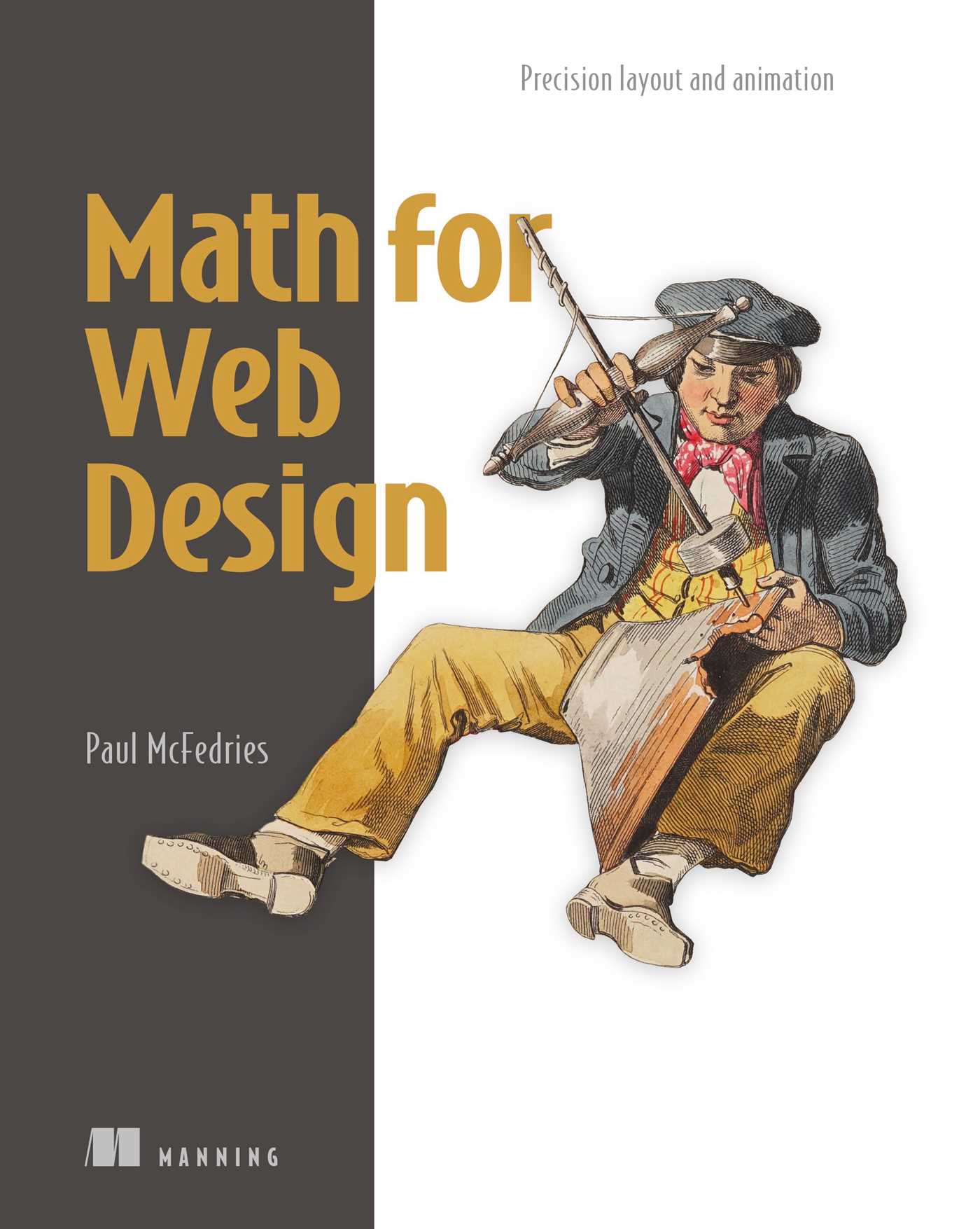
Math for Web Design: Precision layout and animation explains the mathematical principles behind good frontend design. With his engaging writing, author Paul McFedries makes it clear how math, carefully applied in CSS and JavaScript, solves everyday design problems such as distributing space, choosing accessible colors, positioning elements, and making animation feel natural. When you understand the calculations behind color, geometry, and motion, you can design with more precision, debug behavior more confidently, and create interfaces that are both attractive and functional.
You’ll start with the basics. Early chapters introduce the minimum math you need, then connect it immediately to front-end tools. From there, the book moves into real layout systems, showing how CSS units are computed, how inheritance affects sizes, how the box model changes formulas, and how Grid and Flexbox distribute space.
The middle chapters focus on responsive and visual decisions that define modern web design. You’ll work through percentage-based and viewport-based layouts, media query logic, liquid layouts, and custom clamp() formulas. You’ll also learn the mathematics of color, including color conversion, harmonious palettes, WCAG contrast ratios, alpha compositing, and blend modes. Typography receives the same practical treatment, with formulas for font size, line height, line length, fluid type, and modular scales.
Later chapters move into the math of interaction, motion, and richer UI effects. You’ll use trigonometry for circular menus, spinners, wave paths, and directional calculations, along with vectors and geometry to align components, create hover and parallax effects, and constrain dragging. The book then extends this foundation into Bezier curves, CSS easing, gesture math, and scroll-based animation.
Math for Web Design is a masterful guided tour through the math front-end professionals actually use. Each concept appears because it solves a concrete design or implementation problem. CSS and JavaScript examples keep the explanations grounded, while exercises and solutions help you build fluency. You’ll appreciate how this book builds a durable mental model layer by layer, connecting fundamentals to layout, color, typography, animation, interaction, and canvas work in a sequence you can revisit as a practical reference.
What's inside
• CSS and JavaScript math fundamentals
• Grid, Flexbox, responsive layout, and fluid sizing
• Color, accessibility, typography, and blending
• Geometry, trigonometry, interaction, and animation math
About the reader
For developers, designers, and UX/UI professionals who know CSS and JavaScript. No advanced math knowledge required.
About the author
Paul McFedries has been a professional technical writer for more than 30 years. He is the author of Manning’s Web Design Playground, Second Edition, and Build a Website with ChatGPT. His 100+ books have sold more than 4 million copies worldwide.
Table of Contents
1 Web dev math fundamentals
2 Math basics for JavaScript
3 Math basics for CSS
4 CSS Grid math
5 Flexbox math
6 The mathematics of responsive design
7 The mathematics of color
8 Text and typography math
9 Trigonometry for web developers
10 Vectors and geometry in UI design
11 Using Bézier curves for smooth animation
12 Physics-based animations
13 Interactivity and gesture-based UI math
14 Canvas-based math and drawing
"A necessity for designing bulletproof layouts.”
—Chris Kardell, Centennial Bank
Math for Web Design: Precision layout and animation explains the mathematical principles behind good frontend design. With his engaging writing, author Paul McFedries makes it clear how math, carefully applied in CSS and JavaScript, solves everyday design problems such as distributing space, choosing accessible colors, positioning elements, and making animation feel natural. When you understand the calculations behind color, geometry, and motion, you can design with more precision, debug behavior more confidently, and create interfaces that are both attractive and functional.
You’ll start with the basics. Early chapters introduce the minimum math you need, then connect it immediately to front-end tools. From there, the book moves into real layout systems, showing how CSS units are computed, how inheritance affects sizes, how the box model changes formulas, and how Grid and Flexbox distribute space.
The middle chapters focus on responsive and visual decisions that define modern web design. You’ll work through percentage-based and viewport-based layouts, media query logic, liquid layouts, and custom clamp() formulas. You’ll also learn the mathematics of color, including color conversion, harmonious palettes, WCAG contrast ratios, alpha compositing, and blend modes. Typography receives the same practical treatment, with formulas for font size, line height, line length, fluid type, and modular scales.
Later chapters move into the math of interaction, motion, and richer UI effects. You’ll use trigonometry for circular menus, spinners, wave paths, and directional calculations, along with vectors and geometry to align components, create hover and parallax effects, and constrain dragging. The book then extends this foundation into Bezier curves, CSS easing, gesture math, and scroll-based animation.
Math for Web Design is a masterful guided tour through the math front-end professionals actually use. Each concept appears because it solves a concrete design or implementation problem. CSS and JavaScript examples keep the explanations grounded, while exercises and solutions help you build fluency. You’ll appreciate how this book builds a durable mental model layer by layer, connecting fundamentals to layout, color, typography, animation, interaction, and canvas work in a sequence you can revisit as a practical reference.
What's inside
• CSS and JavaScript math fundamentals
• Grid, Flexbox, responsive layout, and fluid sizing
• Color, accessibility, typography, and blending
• Geometry, trigonometry, interaction, and animation math
About the reader
For developers, designers, and UX/UI professionals who know CSS and JavaScript. No advanced math knowledge required.
About the author
Paul McFedries has been a professional technical writer for more than 30 years. He is the author of Manning’s Web Design Playground, Second Edition, and Build a Website with ChatGPT. His 100+ books have sold more than 4 million copies worldwide.
Table of Contents
1 Web dev math fundamentals
2 Math basics for JavaScript
3 Math basics for CSS
4 CSS Grid math
5 Flexbox math
6 The mathematics of responsive design
7 The mathematics of color
8 Text and typography math
9 Trigonometry for web developers
10 Vectors and geometry in UI design
11 Using Bézier curves for smooth animation
12 Physics-based animations
13 Interactivity and gesture-based UI math
14 Canvas-based math and drawing
Product Details
- Publisher: Manning (July 7, 2026)
- Length: 400 pages
- ISBN13: 9781638358060
Browse Related Books
Resources and Downloads
High Resolution Images
-
Book Cover Image (jpg): Math for Web Design
eBook 9781638358060