Plus get our latest book recommendations, author news, and competitions right to your inbox.
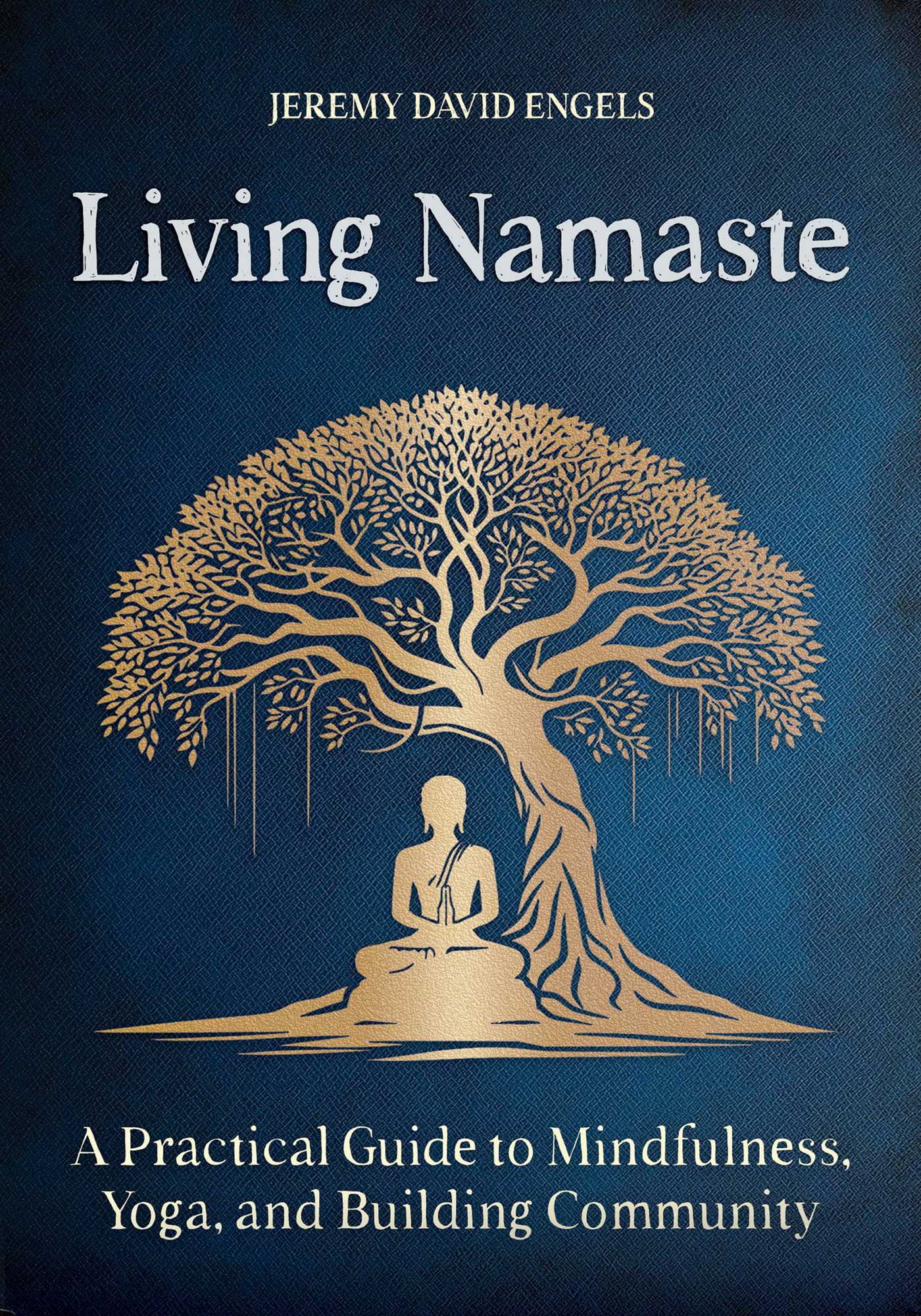
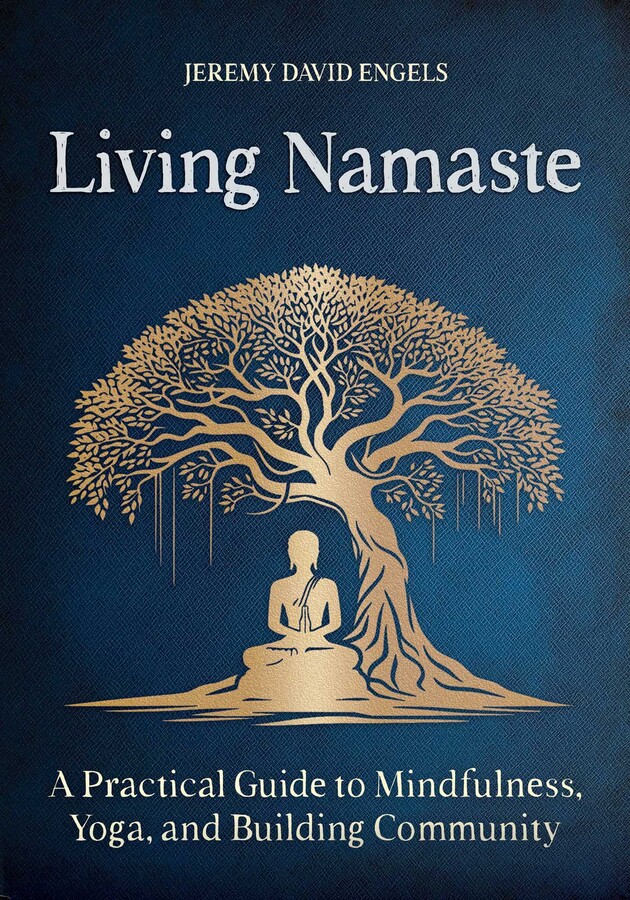
Living Namaste
A Practical Guide to Mindfulness, Yoga, and Building Community
Published by Inner Traditions
Distributed by Simon & Schuster
Table of Contents
About The Book
“An appealing manual that offers encouraging methods for pursuing a happier and more connected life.”—Kirkus Reviews
• Defines the meaning of “namaste” and explains how to apply it in daily interactions to build stronger communities
• Offers practical strategies to develop self-awareness and compassion, foster deeper connections with others, and support mutual growth
• Includes exercises, mindfulness meditations, and svadhyaya (“self-study”) practices to deepen personal growth and understanding
Namaste is a Sanskrit greeting that means “I bow to the divine in you.” It has become a common phrase to say at the end of yoga classes, but as Jeremy Engels shows, “namaste” is more than a polite expression; it is a powerful principle for building connection and community.
Engels organizes the practice of living namaste around three reminders—“I am divine,” “you are divine,” and “live the word, together”—noting that the significance of mindfulness and yoga practice is about remembering to return to a state of awareness, presence, and connection.
The practical approach Engels offers in Living Namaste encourages self-awareness and empathy, cultivating gratitude, and treating one another with compassion to foster deeper connections and support mutual growth. Each of the three reminders is accompanied by exercises, mindfulness meditations, and svadhyaya (“self-study”) practices designed to help you apply these teachings to your daily life. By responding thoughtfully and with care to each other, rather than reactively, readers can form stronger, more supportive relationships, support each other’s well-being, and contribute to healthier communities.
• Defines the meaning of “namaste” and explains how to apply it in daily interactions to build stronger communities
• Offers practical strategies to develop self-awareness and compassion, foster deeper connections with others, and support mutual growth
• Includes exercises, mindfulness meditations, and svadhyaya (“self-study”) practices to deepen personal growth and understanding
Namaste is a Sanskrit greeting that means “I bow to the divine in you.” It has become a common phrase to say at the end of yoga classes, but as Jeremy Engels shows, “namaste” is more than a polite expression; it is a powerful principle for building connection and community.
Engels organizes the practice of living namaste around three reminders—“I am divine,” “you are divine,” and “live the word, together”—noting that the significance of mindfulness and yoga practice is about remembering to return to a state of awareness, presence, and connection.
The practical approach Engels offers in Living Namaste encourages self-awareness and empathy, cultivating gratitude, and treating one another with compassion to foster deeper connections and support mutual growth. Each of the three reminders is accompanied by exercises, mindfulness meditations, and svadhyaya (“self-study”) practices designed to help you apply these teachings to your daily life. By responding thoughtfully and with care to each other, rather than reactively, readers can form stronger, more supportive relationships, support each other’s well-being, and contribute to healthier communities.
Excerpt
1
Connect to the Divine Within
नमस्ते
Na-ma-ste (n):
I bow to you
The divine in me bows to the divine in you
The time you set aside to practice yoga is a beautiful gift you give to yourself. During that time, you have full permission to unplug from the distractions and worries that dog your days. Think of how good it feels to step onto the mat, take a few deep breaths, let your neck and shoulders relax, and settle into the now, where you belong. Practicing yoga is coming home to the present moment. When you’re on the mat, there is nowhere else you need to be, and nothing else you need to be doing other than connecting your mind, body, breath, and spirit.
And then—almost as quickly as it began—practice is over, and you return to real life, which is all too often busy, rushed, lonely, and disconnected.
But maybe, like me, you’re someone who doesn’t want the practice to end.
Maybe you’re someone who wants to feel that sense of inner peace, of connection, of being fully present, all the time.
Maybe you want to bring yoga into your life, into your relationships, into your community, and into the world, creating a sense of real and lasting transformation for the better.
Maybe you want your entire life to feel like a beautiful gift.
If so, then this book is written for you.
In your yoga practice, namaste is the peak pose.
Namaste can transform your life.
Namaste can transform the world.
But for namaste to reach its full potential, it must be lived. First you have to understand it, then you have to really mean it when you say it, and finally you have to embody its wisdom in your daily life. This book shows you how to achieve one foundational goal of practicing yoga: to learn to live the wisdom of namaste. Our starting place is the same place that any yoga practice begins: with fundamentals. If namaste is a peak pose, you must build it from the ground up, ensuring that it rests on a strong foundation.
Namaste means “the divine in me bows to the divine in you.” So when you say namaste, it is an invitation to recognize the divine in yourself. At its most fundamental, namaste is a reminder of your own divinity. In today’s world, acknowledging the divine within is a tremendous leap, one most people need support with. What does “the divine within” mean? What does it mean to call ourselves “divine”? These are the questions explored in this first chapter.
Here you’ll learn how to connect to the divine within, and how to tap into your own inner peace, through mindful breathing. This mindfulness practice will become the foundation you return to in future chapters when exploring how connecting to the divine within can help you navigate moments of difficulty and challenge. Consider this chapter the first step on a new yoga journey, one where the practice doesn’t end as you step off the mat and the best things about yoga—the feelings of inner peace, connection, and being fully present—become more readily available to you every day, in all parts of your life.
A BRIEF HISTORY OF NAMASTE
Originally a Sanskrit word, namaste is composed of two shorter words—namas means “bow, bend, or honor,” and te means “to you.” Literally namaste means “I bow to you.” In Hindi and a number of other languages derived from Sanskrit, namaste is basically a respectful way of saying hello and also goodbye (like aloha, it can mean both). Today, namaste has been adopted into the English language along with countless other words from non-English sources. From Sanskrit alone, we get the words yoga, avatar, guru, jungle, karma, shampoo, veranda, thug, loot, and punch. Many of these loan words are adopted wholesale from other languages, retaining their original spelling and meaning. Other words, when borrowed, keep their original spelling but acquire new meanings in English. This is the case with namaste—it has shifted from meaning simply “I bow to you” to “the divine in me bows to the divine in you.” Understanding this newer meaning is the key to Living Namaste.
While it is impossible to say for certain, it is most likely due to the influence of Ram Dass in the 1960s and 1970s that the meaning of namaste changed. A charismatic spiritual teacher and bestselling author (his most popular book is: Be Here Now) with a background in psychology, Dass toured college campuses and popularized yoga, meditation, and psychedelics as a countercultural lifestyle choice for a discontented generation. In his book The Only Dance There Is, based on talks he gave in 1970 and 1972, Dass wrote:
In India when people meet and part, instead of saying hello or
goodbye, they say something to each other . . . which reminds
us of who we are . . . The word they use is Namasta. Na-masta.
It means “I honor the light within you.” So may I close by
saying to all of you, Namasta.1
In Polishing the Mirror, he expands this definition as he recounts his experience studying meditation in India:
In India when people meet and they part they say “Namaste,” which means:
I honor the place in you
Where the entire universe resides.
I honor the place in you
Of love, of light, of truth, of peace.
I honor the place in you
Where if you are in that place in you and
I am in that place in me,
There is only one of us.2
Ram Dass captures a word in motion. Many common salutations have religious roots, including the Spanish and French words for goodbye: adios and adieu, or “a Dios” and “a Dieu”—literally meaning “to God.” These words are a way of saying “go with God.” This is even true of the English word goodbye—a contraction of “God be with you.” Most Indian religions and spiritual traditions agree that there is something divine in all people. Tracing the evolving meaning of namaste, it is understandable how the word shifted from meaning “I bow to you” to “the divine in me bows to the divine in you.” During the counter-cultural revolution of the 1960s and 1970s, namaste evolved from a simple greeting and parting to a word that is a mini meditation on the interconnectedness and shared divinity of all beings.
Fast-forward a couple of decades. As yoga’s popularity exploded in the 1990s and early 2000s, namaste became more popular, too.3 One of the most prominent yoga teachers of this period is Shiva Rea. She introduced many Americans to the flowing sequence of postures called sun salutations, and became such a prominent celebrity that Vanity Fair dubbed her “the Madonna of the yoga world.” She also popularized saying namaste at the end of practice.4 In her words, namaste means “I bow to the divinity within you from the divinity within me.” “This salutation is considered to be the essence of the yogic practice of seeing the divine within all creation,” she writes.5 The New Age guru Deepak Chopra, who introduced many Americans to Indian philosophy as they followed what he called the “seven laws of spiritual success,” repeated a similar definition: “‘namaste’ means ‘the spirit in me honors the spirit in you’ and ‘the divine in me honors the divine in you.’”6 One of my own meditation teachers, Tara Brach, describes namaste as a practice of “soul recognition” that involves “realizing and honoring the sacredness that shines through all beings.”7
Today we need words of connection, words of unity, words that remind us of how much we share. This is exactly what namaste does. Said with intention, namaste is not just another three-syllable word muttered automatically, like bandana or pajama (two other words borrowed from Sanskrit and Hindi). When you bow to another person, you are honoring something precious in them, you are acknowledging that they are sacred and worthy of respect, you are recognizing that they are a light in a world that can be dark and stormy—and if that light were to go out, our shared world would be dimmer.
But namaste does not simply mean “I bow to the divine in you”—it means “the divine in me bows to the divine in you.” The first of the three reminders of namaste is I Am Divine. There is something in you, too, dear reader, that is sacred and worthy of respect. You are a light in the dark. The world would be dimmer if your light were to go out. Each time you say namaste, it should come from a place of deep embodied understanding of your own divinity.
Connect to the Divine Within
नमस्ते
Na-ma-ste (n):
I bow to you
The divine in me bows to the divine in you
The time you set aside to practice yoga is a beautiful gift you give to yourself. During that time, you have full permission to unplug from the distractions and worries that dog your days. Think of how good it feels to step onto the mat, take a few deep breaths, let your neck and shoulders relax, and settle into the now, where you belong. Practicing yoga is coming home to the present moment. When you’re on the mat, there is nowhere else you need to be, and nothing else you need to be doing other than connecting your mind, body, breath, and spirit.
And then—almost as quickly as it began—practice is over, and you return to real life, which is all too often busy, rushed, lonely, and disconnected.
But maybe, like me, you’re someone who doesn’t want the practice to end.
Maybe you’re someone who wants to feel that sense of inner peace, of connection, of being fully present, all the time.
Maybe you want to bring yoga into your life, into your relationships, into your community, and into the world, creating a sense of real and lasting transformation for the better.
Maybe you want your entire life to feel like a beautiful gift.
If so, then this book is written for you.
In your yoga practice, namaste is the peak pose.
Namaste can transform your life.
Namaste can transform the world.
But for namaste to reach its full potential, it must be lived. First you have to understand it, then you have to really mean it when you say it, and finally you have to embody its wisdom in your daily life. This book shows you how to achieve one foundational goal of practicing yoga: to learn to live the wisdom of namaste. Our starting place is the same place that any yoga practice begins: with fundamentals. If namaste is a peak pose, you must build it from the ground up, ensuring that it rests on a strong foundation.
Namaste means “the divine in me bows to the divine in you.” So when you say namaste, it is an invitation to recognize the divine in yourself. At its most fundamental, namaste is a reminder of your own divinity. In today’s world, acknowledging the divine within is a tremendous leap, one most people need support with. What does “the divine within” mean? What does it mean to call ourselves “divine”? These are the questions explored in this first chapter.
Here you’ll learn how to connect to the divine within, and how to tap into your own inner peace, through mindful breathing. This mindfulness practice will become the foundation you return to in future chapters when exploring how connecting to the divine within can help you navigate moments of difficulty and challenge. Consider this chapter the first step on a new yoga journey, one where the practice doesn’t end as you step off the mat and the best things about yoga—the feelings of inner peace, connection, and being fully present—become more readily available to you every day, in all parts of your life.
A BRIEF HISTORY OF NAMASTE
Originally a Sanskrit word, namaste is composed of two shorter words—namas means “bow, bend, or honor,” and te means “to you.” Literally namaste means “I bow to you.” In Hindi and a number of other languages derived from Sanskrit, namaste is basically a respectful way of saying hello and also goodbye (like aloha, it can mean both). Today, namaste has been adopted into the English language along with countless other words from non-English sources. From Sanskrit alone, we get the words yoga, avatar, guru, jungle, karma, shampoo, veranda, thug, loot, and punch. Many of these loan words are adopted wholesale from other languages, retaining their original spelling and meaning. Other words, when borrowed, keep their original spelling but acquire new meanings in English. This is the case with namaste—it has shifted from meaning simply “I bow to you” to “the divine in me bows to the divine in you.” Understanding this newer meaning is the key to Living Namaste.
While it is impossible to say for certain, it is most likely due to the influence of Ram Dass in the 1960s and 1970s that the meaning of namaste changed. A charismatic spiritual teacher and bestselling author (his most popular book is: Be Here Now) with a background in psychology, Dass toured college campuses and popularized yoga, meditation, and psychedelics as a countercultural lifestyle choice for a discontented generation. In his book The Only Dance There Is, based on talks he gave in 1970 and 1972, Dass wrote:
In India when people meet and part, instead of saying hello or
goodbye, they say something to each other . . . which reminds
us of who we are . . . The word they use is Namasta. Na-masta.
It means “I honor the light within you.” So may I close by
saying to all of you, Namasta.1
In Polishing the Mirror, he expands this definition as he recounts his experience studying meditation in India:
In India when people meet and they part they say “Namaste,” which means:
I honor the place in you
Where the entire universe resides.
I honor the place in you
Of love, of light, of truth, of peace.
I honor the place in you
Where if you are in that place in you and
I am in that place in me,
There is only one of us.2
Ram Dass captures a word in motion. Many common salutations have religious roots, including the Spanish and French words for goodbye: adios and adieu, or “a Dios” and “a Dieu”—literally meaning “to God.” These words are a way of saying “go with God.” This is even true of the English word goodbye—a contraction of “God be with you.” Most Indian religions and spiritual traditions agree that there is something divine in all people. Tracing the evolving meaning of namaste, it is understandable how the word shifted from meaning “I bow to you” to “the divine in me bows to the divine in you.” During the counter-cultural revolution of the 1960s and 1970s, namaste evolved from a simple greeting and parting to a word that is a mini meditation on the interconnectedness and shared divinity of all beings.
Fast-forward a couple of decades. As yoga’s popularity exploded in the 1990s and early 2000s, namaste became more popular, too.3 One of the most prominent yoga teachers of this period is Shiva Rea. She introduced many Americans to the flowing sequence of postures called sun salutations, and became such a prominent celebrity that Vanity Fair dubbed her “the Madonna of the yoga world.” She also popularized saying namaste at the end of practice.4 In her words, namaste means “I bow to the divinity within you from the divinity within me.” “This salutation is considered to be the essence of the yogic practice of seeing the divine within all creation,” she writes.5 The New Age guru Deepak Chopra, who introduced many Americans to Indian philosophy as they followed what he called the “seven laws of spiritual success,” repeated a similar definition: “‘namaste’ means ‘the spirit in me honors the spirit in you’ and ‘the divine in me honors the divine in you.’”6 One of my own meditation teachers, Tara Brach, describes namaste as a practice of “soul recognition” that involves “realizing and honoring the sacredness that shines through all beings.”7
Today we need words of connection, words of unity, words that remind us of how much we share. This is exactly what namaste does. Said with intention, namaste is not just another three-syllable word muttered automatically, like bandana or pajama (two other words borrowed from Sanskrit and Hindi). When you bow to another person, you are honoring something precious in them, you are acknowledging that they are sacred and worthy of respect, you are recognizing that they are a light in a world that can be dark and stormy—and if that light were to go out, our shared world would be dimmer.
But namaste does not simply mean “I bow to the divine in you”—it means “the divine in me bows to the divine in you.” The first of the three reminders of namaste is I Am Divine. There is something in you, too, dear reader, that is sacred and worthy of respect. You are a light in the dark. The world would be dimmer if your light were to go out. Each time you say namaste, it should come from a place of deep embodied understanding of your own divinity.
Product Details
- Publisher: Inner Traditions (June 16, 2026)
- Length: 192 pages
- ISBN13: 9798888503041
Browse Related Books
Raves and Reviews
“The beautiful greeting Namaste invites a sacred connection. This book shows us how to embody this spirit with care and compassion.”
– Jack Kornfield, author of A Path with Heart
“The heart-opening practices in this wise book help us recognize the sacredness that shines through this living world.”
– Tara Brach, PhD, author of Radical Acceptance and Trusting the Gold
“Jeremy David Engels provides practices of embodied Namaste that will transform your life. Embrace the Divine Grace within you and around you—one greeting, one bow, and one breath at a time. Share the heartfelt compassion inherent in Namaste with everyone you greet. This Divine vibration can change the world.”
– Keith Lowenstein, MD, LFAPA, MDiv, author of Kriya Yoga for Self-Discovery
Resources and Downloads
High Resolution Images
-
Book Cover Image (jpg): Living Namaste
eBook 9798888503041