Plus get our latest book recommendations, author news, and competitions right to your inbox.
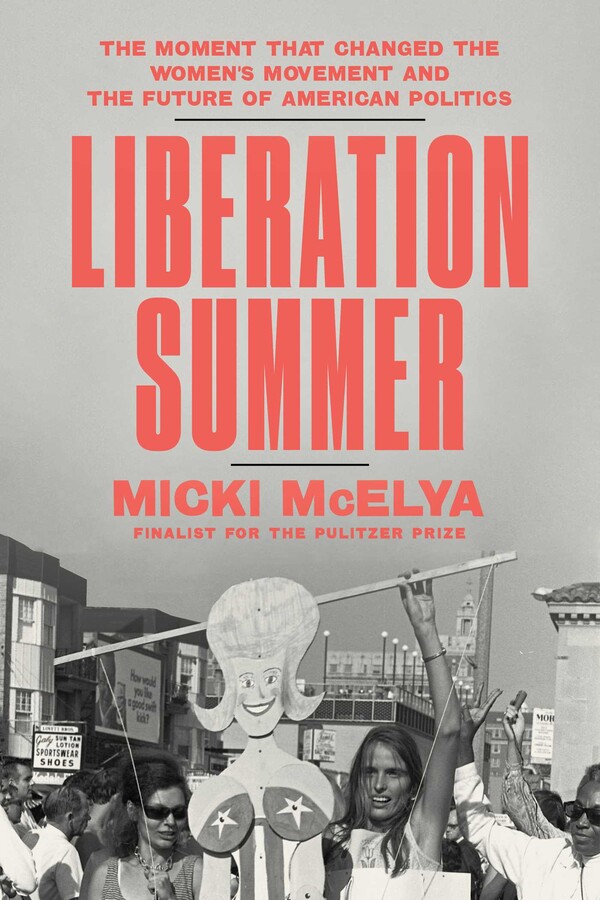
Liberation Summer
The Moment That Changed the Women's Movement and the Future of American Politics
By Micki McElya
Table of Contents
About The Book
A sweeping, definitive work of history exploring the road to the September 1968 protests of the Miss American Pageant—one led by women’s liberationists and the other organized by the emergent Miss Black America Pageant—and the birth of a new politics of beauty.
A revolution was brewing. In the dying days of the summer of 1968, during one unprecedented Pageant weekend, Atlantic City played host not only to the fifty young contestants and thousands of eager visitors who had arrived in town for the Miss America crowning, but also to the first Miss Black America Pageant, mounted to protest its “lily-white” sister competition, as well as raucous actions from women’s liberationists. For just a few hours, the boardwalk became a site of vigorously contested ideas—ideas that would redefine the women’s movement and reverberate across American culture.
Now, Pulitzer Prize finalist Micki McElya unfolds the full scope of this history, detailing the shocking injustices and passionate debates that led to the demonstrations, as well as the broader social and political landscape that gave rise to some of the most iconic women on both sides of the ideological spectrum. Here, we find complex portraits of Betty Friedan, Gloria Steinem, Florynce Kennedy, Phyllis Schlafly, and Anita Bryant as well as glimpses of Hillary Rodham Clinton, John Lewis, Vanessa Williams, and Donald Trump years before they became the public figures we know them as today.
Immersive, galvanizing, and endlessly edifying, Liberation Summer is also a kaleidoscopic panorama of the year that saw the assassinations of Martin Luther King Jr. and Robert Kennedy, the Tet Offensive and the escalation of the Vietnam War, violence at the Republican and Democratic National Conventions, and the election of Richard Nixon. Within this ever-shifting terrain, lesser-known characters like reporter Charlotte Curtis, radical feminist organizers Robin Morgan and Carol Hanisch, Miss America 1968 Debra Barnes, and the first Miss Black America Saundra Williams fought to not only define their conception of ideal womanhood, but to live it.
Engagingly told and meticulously researched, Liberation Summer proves how the battle for beauty’s meaning has always been inextricably political—and how its enduring impact continues to shape our politics today.
A revolution was brewing. In the dying days of the summer of 1968, during one unprecedented Pageant weekend, Atlantic City played host not only to the fifty young contestants and thousands of eager visitors who had arrived in town for the Miss America crowning, but also to the first Miss Black America Pageant, mounted to protest its “lily-white” sister competition, as well as raucous actions from women’s liberationists. For just a few hours, the boardwalk became a site of vigorously contested ideas—ideas that would redefine the women’s movement and reverberate across American culture.
Now, Pulitzer Prize finalist Micki McElya unfolds the full scope of this history, detailing the shocking injustices and passionate debates that led to the demonstrations, as well as the broader social and political landscape that gave rise to some of the most iconic women on both sides of the ideological spectrum. Here, we find complex portraits of Betty Friedan, Gloria Steinem, Florynce Kennedy, Phyllis Schlafly, and Anita Bryant as well as glimpses of Hillary Rodham Clinton, John Lewis, Vanessa Williams, and Donald Trump years before they became the public figures we know them as today.
Immersive, galvanizing, and endlessly edifying, Liberation Summer is also a kaleidoscopic panorama of the year that saw the assassinations of Martin Luther King Jr. and Robert Kennedy, the Tet Offensive and the escalation of the Vietnam War, violence at the Republican and Democratic National Conventions, and the election of Richard Nixon. Within this ever-shifting terrain, lesser-known characters like reporter Charlotte Curtis, radical feminist organizers Robin Morgan and Carol Hanisch, Miss America 1968 Debra Barnes, and the first Miss Black America Saundra Williams fought to not only define their conception of ideal womanhood, but to live it.
Engagingly told and meticulously researched, Liberation Summer proves how the battle for beauty’s meaning has always been inextricably political—and how its enduring impact continues to shape our politics today.
Excerpt
Chapter 1: New Feminist Eyes 1 NEW FEMINIST EYES
JUNE 4–6, 1968
Another man was explaining the revolution to Roxanne Dunbar. Sitting in a tile-covered eighteenth-century palace turned café at the heart of Mexico City’s Centro Histórico, she tried to focus on the centuries of history that surrounded her. Pancho Villa and the Zapatistas had once occupied the palace during the Mexican Revolution; now, on an afternoon in early June 1968, they gazed at her from old photos lining the café’s walls. It was all so beautiful and inspiring, she thought. She could not say the same for the conversation.
Nearly two months into her stay in Mexico, Dunbar was feeling restless. She was supposed to have been in Cuba by now. That, at least, had been the plan when she and her boyfriend, Jean-Louis, left Berkeley, California, to stay with his family in Mexico while making the necessary travel arrangements. Like many young radicals in America, they wanted to help build a truly socialist society on the island so that one day, they would know how to do the same in the United States. The couple were both graduate students, she in history and he in French, but Dunbar mainly thought of herself as an activist, while Louis, as she called him, had grown more enmeshed in the counterculture. The difference in perspective—making a revolution versus rejecting mainstream society in pursuit of new ways of being and expression—had troubled their already stormy relationship. While Jean-Louis had grown up in Mexico, he and his family were French; nationals from both countries were free to travel to Cuba uninhibited. As an American, Dunbar’s trip to the communist nation had been more difficult to arrange. Cuba had been under embargo since 1962 and was effectively closed to U.S. citizens. Passage through Mexico was the best option, but it wasn’t an easy or fast one. Hoping to speed things along with a new passport, Dunbar had married Jean-Louis in Mexico City, a decision she soon regretted as she watched him slide so easily into the comforts and racial hierarchies of his family’s wealth and status in Mexico. So much for radicalism, she thought. When he had announced a new plan to move to France, Dunbar had been more angry than surprised. He was free to go, she had said, but she was moving to Cuba—as soon as her papers came through.
Now, Jean-Louis sat beside her in the café, arm draped around her shoulders in a maddening if mundane assertion of possession. The man across from them continued talking, drumming a rolled-up newspaper against the palm of his hand for emphasis. It was only when he paused to unfurl the paper and jab at an article to prove some point that she saw it: “Super Woman-Power Advocate Shoots Andy Warhol.”
She grabbed the paper and devoured the slim facts of the story. The artist and another man had been shot the day before in New York City, and the woman who shot them, Valerie Solanas, had surrendered to police a few hours later. Both men had survived, but Warhol remained in critical condition. Solanas, according to the report, was the author of a manifesto for a group called the Society for Cutting Up Men, or SCUM.
Super Woman-Power Advocate.
Woman Power.
Dunbar gripped the paper, oblivious to the world around her and hungry for more information. Could it be true that women were finally rising up?
What if she stuck to her plan of going to Cuba to learn from their revolution and missed her own at home?
Solanas had changed everything; Roxanne Dunbar would not be going to Cuba after all.
Two thousand miles away, Andy Warhol’s condition at a Manhattan hospital was still critical when Robert F. Kennedy was shot in Los Angeles at the Ambassador Hotel, shortly after winning the California Democratic presidential primary. The next morning, June 6, Bobby Kennedy was declared dead.
Upon hearing the news, Bev Grant, an activist, musician, and photographer, walked out of her apartment with her camera and into the early summer air on New York City’s Lower East Side. She set out on a familiar path uptown, past favorite diners and university buildings along NYU’s creeping eastern border. A sickening feeling of déjà vu had fallen over Grant—she had been twenty-one when the country was plunged into horrified mourning over the death of Robert Kennedy’s brother five years earlier; more recently, a woman had interrupted an activist meeting she’d been attending with the news that Dr. Martin Luther King Jr. had been murdered in Memphis. As she weaved her way through familiar streets, Grant took in her adopted city as it took in the news of Kennedy’s death. Everyone looked as stunned as she felt. She headed toward Union Square and the small stretch of Broadway between 14th and 17th Streets that had become so much a part of her daily routine. There, she hopped on an uptown subway to 42nd Street and Times Square, where she found the headline zipper at One Times Square had not been updated: “KENNEDY STILL UNCONSCIOUS” ran in all-capital letters around the low belly of the building.
Originally from Oregon, Grant had married young and moved to New York so her husband could pursue his career as a jazz musician. The couple divorced not long after, but as one relationship ended, another blossomed. New York City was Grant’s new love, encouraging her evolution as an artist and activist. In 1964, she read Simone de Beauvoir’s The Second Sex, an experience that stuck with her less for the text and more for the fact her boyfriend at the time had grabbed the book and thrown it out when she tried to discuss it with him. Three years later, while attending a Students for a Democratic Society (SDS) meeting at Princeton University in New Jersey, she saw a notice for a lunchtime workshop for women organized by Shulamith Firestone and Pam Allen. “It was a life-changing experience for me,” Grant explained later. “I began to understand that my life was an example of a social problem shared by women, something we were capable of changing.”
Bev Grant wasn’t the only woman to leave that workshop transformed and eager to make change. Several of the women in attendance, including Grant, formed the original core of New York’s first women’s liberation group that would in 1967 become New York Radical Women (NYRW). It had been during one of the group’s weekly Thursday meetings that she and the others first learned of King’s assassination. Now, two months later, another Thursday brought yet another assassination, and the women would be meeting that night.
Temperatures in the city climbed as that sad, strange Thursday wore on, making it feel more like August than early June. New York was enveloped in a heat wave thanks to Hurricane Abby, which was making a slow churn up the coast. The first officially dangerous storm of the season had a woman’s name, as always, taken from the alphabetical list of all-female-coded names published annually by the National Hurricane Center. Abby would be followed by Brenda and Candy.
It was a blessing that attendance was smaller than usual for a NYRW meeting. The roughly twenty women didn’t have to sit shoulder to hot, clammy shoulder on the low-slung couch, in the limited chairs, on tops of desks, or on the black-and-white checkerboard linoleum floor. It also meant that late arrivals weren’t stuck in the alcove near the door, which always made them feel a little out of the action and more like spectators. The space belonged to Carol Hanisch’s employer, the Southern Conference Educational Fund (SCEF), a civil rights organization run by married activist legends Anne and Carl Braden, in Kentucky. For the last two years, she’d managed their New York office; for the last several months, the Bradens had allowed Hanisch to use the space after hours for women’s liberation meetings.
SCEF, as the women called it (pronounced “Skeff”), was on the fourth floor of a nineteenth-century building on Broadway, at the corner of 11th Street. Shadowed by the Gothic Revival grandeur of Grace Church, across the street, it had been designed as a hotel by the same architect to complement the historic religious institution. The St. Denis Hotel became host to the likes of Mark Twain, Sarah Bernhardt, and Ulysses S. Grant; in 1877, Alexander Graham Bell chose it for the first public demonstration in New York of his latest invention, the telephone. After changing hands in the early twentieth century and failing under the new owners, it had been stripped of its ornamentation and eventually converted to an unremarkable six-story office building.
With its assortment of mismatched furniture and propped-up bulletin boards covered in schedules and flyers, room 412 appeared the epitome of an activist organization office put together on the cheap, just like many others on the fourth floor and scattered throughout the building. Wide metal bookshelves designed to be sturdy and useful rather than decorative were pushed up against one wall, housing a hodgepodge of messy stacks of paper, coffee mugs, boxes of printed materials, and a bottle of dish soap, while several metal filing cabinets lined another wall. The space wasn’t large, but it was a much better option than rotating among the organizers’ cramped tenement apartments as word spread and more women showed up each week.
Hanisch wasn’t surprised by the low turnout for the meeting that night. Rosalyn Baxandall was on Cape Cod with her husband and young toddler; Shulamith Firestone and “the Annes” (Anne Forer and Anne Koedt) were all in France. Kathie AmatniekI—probably the person Hanisch missed the most—was in San Francisco trying to make it work with her boyfriend while bringing NYRW’s methods of consciousness raising (CR) to the two women’s liberation groups she’d found out there. Hanisch would be leaving soon herself to join other regional SCEF representatives for several weeks of work with the Bradens in Louisville, Kentucky.
Like Amatniek, Hanisch believed CR was the key to making women’s liberation a mass movement—that bringing women together to share individual experiences of the same situations would allow them to see that the problems and limitations they faced were common ones, not just isolated personal issues or cases of maladjustment. The sessions bonded the women while making them aware of their collective structural oppression—raising their consciousness—and thus creating the basis for organizing and change. Amatniek had always been the more assertive of the pair. If she had been there that night, rather than in San Francisco with her boyfriend, Ted, they might be starting the CR session Hanisch had wanted.
Instead, a woman lugged in a 16-mm film projector and the group prepared to watch an avant-garde film Hanisch had never heard of. Given the office’s spare furnishings and minimal decoration, the setup was easy. When someone hit the lights, the projector’s beam caught the cigarette smoke that hung thickly in the still, hot air. Its mechanical whir blended with the sounds of Broadway’s traffic coming through the open windows from four stories below.
Dracula music—Bach’s Toccata and Fugue in D minor, for organ—sliced through the noise as the black-and-white film began. It cut from jumpy shots of a wooded landscape to a woman’s silhouetted head and shoulders, as thin swirls of paint came together to make the film’s title: Schmeerguntz.
The ominous, if somewhat ridiculous, music continued over a new image of what appeared to be flesh, soon revealed to be an extreme close-up of an enormously pregnant stomach, skin straining, belly button popped out. A small figure cut from a magazine moved around the stomach like a little astronaut in jittery orbit. Then the stomach became the moon and more little astronauts skittered into and then out of the scene.
Hanisch had been irritated already, and nothing about this film was changing her mood. What is the point of this, she thought, as the jumpy cuts and collaged images continued—magazine advertisements and fashion shoots featuring pretty young white women; makeup, shampoos, trendy clothes, toothy smiles, and pouting lips interspersed with scenes of the pregnant woman in various rooms of a cluttered house. In one, she soaked in a shallow tub, soap suds bobbing around her painfully large belly, breasts, and knees that poked high above the waterline; in another, she rested on an unmade bed; she folded laundry; she shaved her armpit; she considered a sink full of dirty dishes; she vomited into an already filthy-looking toilet basin; she got dressed while awkwardly negotiating her own body. At one point, Bach’s organ piece was replaced by a series of audio clips of disembodied male voices narrating snippets of romantic scenes, including the moment in the film Sleeping Beauty when the princess is finally awakened by the prince’s kiss. Jangling calliope music played over a manipulated photo of a group of nineteenth-century European theology students, all men, ice skating and frolicking like boys; next appeared a Clorox advertisement featuring a group of women of various ages in smocks and maid’s uniforms.
Hanisch stewed as the vomit swirling around a flushed toilet dissipated into women gliding around a roller rink as a man sang a song about the USA and apple pie. Then, the scene turned to a long shot of a beauty queen’s crown and scepter resting on a plush, tufted pillow. The pageant theme song continued, and the film cut back to the roller derby. Women in skates and knee pads hit and jostled for supremacy while the crowd cheered and male referees jumped in to break it up. The scene shifted again to historic beauty pageant footage before cutting to recent pageant telecast footage. Miss Illinois and Miss Georgia introduced themselves.
And then it happened.
Hanisch watched as beauty contestants paraded across a stage in swimsuits, heels, and sashes. With smiles plastered across their faces and hair teased and sprayed into immobility, the women presented themselves for judgment by those on the scene and to viewers at home. The shot included the edge of the television screen being filmed—a reminder of the cameras, ever-expectant audiences, and the film viewer’s own spectatorship.II
The images transported Hanisch back to the living room of her childhood home in Havelock, Iowa, where her family had gathered every year to watch the Miss America Pageant. She thought about that scene replicated in the homes of her neighbors and schoolmates, how she and her friends had celebrated each new Miss Iowa, identified with them, and fantasized about one day being crowned Miss America.
Now, seeing the pageant with what she called her “new feminist eyes,” Hanisch was rocked by the monstrous, oppressive spectacle of it all. Oh my God, she thought, staring at the women. There was no glamour here, nothing to celebrate— just fake smiles, empty accolades, and coercive beauty standards.
Later that night, Hanisch moved around the SCEF office performing her Thursday night ritual search for forgotten cups turned makeshift ashtrays; if New York women’s liberation had a signature scent, it was the stale smell of cigarettes and old coffee. She returned chairs to their desks, swept the floor, and closed the windows, all the while still thinking about the pageant. She hadn’t said anything to the others, but now that she had seen Miss America with new eyes, Carol Hanisch couldn’t let it go; or, Miss America wouldn’t let go of her.
JUNE 4–6, 1968
Another man was explaining the revolution to Roxanne Dunbar. Sitting in a tile-covered eighteenth-century palace turned café at the heart of Mexico City’s Centro Histórico, she tried to focus on the centuries of history that surrounded her. Pancho Villa and the Zapatistas had once occupied the palace during the Mexican Revolution; now, on an afternoon in early June 1968, they gazed at her from old photos lining the café’s walls. It was all so beautiful and inspiring, she thought. She could not say the same for the conversation.
Nearly two months into her stay in Mexico, Dunbar was feeling restless. She was supposed to have been in Cuba by now. That, at least, had been the plan when she and her boyfriend, Jean-Louis, left Berkeley, California, to stay with his family in Mexico while making the necessary travel arrangements. Like many young radicals in America, they wanted to help build a truly socialist society on the island so that one day, they would know how to do the same in the United States. The couple were both graduate students, she in history and he in French, but Dunbar mainly thought of herself as an activist, while Louis, as she called him, had grown more enmeshed in the counterculture. The difference in perspective—making a revolution versus rejecting mainstream society in pursuit of new ways of being and expression—had troubled their already stormy relationship. While Jean-Louis had grown up in Mexico, he and his family were French; nationals from both countries were free to travel to Cuba uninhibited. As an American, Dunbar’s trip to the communist nation had been more difficult to arrange. Cuba had been under embargo since 1962 and was effectively closed to U.S. citizens. Passage through Mexico was the best option, but it wasn’t an easy or fast one. Hoping to speed things along with a new passport, Dunbar had married Jean-Louis in Mexico City, a decision she soon regretted as she watched him slide so easily into the comforts and racial hierarchies of his family’s wealth and status in Mexico. So much for radicalism, she thought. When he had announced a new plan to move to France, Dunbar had been more angry than surprised. He was free to go, she had said, but she was moving to Cuba—as soon as her papers came through.
Now, Jean-Louis sat beside her in the café, arm draped around her shoulders in a maddening if mundane assertion of possession. The man across from them continued talking, drumming a rolled-up newspaper against the palm of his hand for emphasis. It was only when he paused to unfurl the paper and jab at an article to prove some point that she saw it: “Super Woman-Power Advocate Shoots Andy Warhol.”
She grabbed the paper and devoured the slim facts of the story. The artist and another man had been shot the day before in New York City, and the woman who shot them, Valerie Solanas, had surrendered to police a few hours later. Both men had survived, but Warhol remained in critical condition. Solanas, according to the report, was the author of a manifesto for a group called the Society for Cutting Up Men, or SCUM.
Super Woman-Power Advocate.
Woman Power.
Dunbar gripped the paper, oblivious to the world around her and hungry for more information. Could it be true that women were finally rising up?
What if she stuck to her plan of going to Cuba to learn from their revolution and missed her own at home?
Solanas had changed everything; Roxanne Dunbar would not be going to Cuba after all.
Two thousand miles away, Andy Warhol’s condition at a Manhattan hospital was still critical when Robert F. Kennedy was shot in Los Angeles at the Ambassador Hotel, shortly after winning the California Democratic presidential primary. The next morning, June 6, Bobby Kennedy was declared dead.
Upon hearing the news, Bev Grant, an activist, musician, and photographer, walked out of her apartment with her camera and into the early summer air on New York City’s Lower East Side. She set out on a familiar path uptown, past favorite diners and university buildings along NYU’s creeping eastern border. A sickening feeling of déjà vu had fallen over Grant—she had been twenty-one when the country was plunged into horrified mourning over the death of Robert Kennedy’s brother five years earlier; more recently, a woman had interrupted an activist meeting she’d been attending with the news that Dr. Martin Luther King Jr. had been murdered in Memphis. As she weaved her way through familiar streets, Grant took in her adopted city as it took in the news of Kennedy’s death. Everyone looked as stunned as she felt. She headed toward Union Square and the small stretch of Broadway between 14th and 17th Streets that had become so much a part of her daily routine. There, she hopped on an uptown subway to 42nd Street and Times Square, where she found the headline zipper at One Times Square had not been updated: “KENNEDY STILL UNCONSCIOUS” ran in all-capital letters around the low belly of the building.
Originally from Oregon, Grant had married young and moved to New York so her husband could pursue his career as a jazz musician. The couple divorced not long after, but as one relationship ended, another blossomed. New York City was Grant’s new love, encouraging her evolution as an artist and activist. In 1964, she read Simone de Beauvoir’s The Second Sex, an experience that stuck with her less for the text and more for the fact her boyfriend at the time had grabbed the book and thrown it out when she tried to discuss it with him. Three years later, while attending a Students for a Democratic Society (SDS) meeting at Princeton University in New Jersey, she saw a notice for a lunchtime workshop for women organized by Shulamith Firestone and Pam Allen. “It was a life-changing experience for me,” Grant explained later. “I began to understand that my life was an example of a social problem shared by women, something we were capable of changing.”
Bev Grant wasn’t the only woman to leave that workshop transformed and eager to make change. Several of the women in attendance, including Grant, formed the original core of New York’s first women’s liberation group that would in 1967 become New York Radical Women (NYRW). It had been during one of the group’s weekly Thursday meetings that she and the others first learned of King’s assassination. Now, two months later, another Thursday brought yet another assassination, and the women would be meeting that night.
Temperatures in the city climbed as that sad, strange Thursday wore on, making it feel more like August than early June. New York was enveloped in a heat wave thanks to Hurricane Abby, which was making a slow churn up the coast. The first officially dangerous storm of the season had a woman’s name, as always, taken from the alphabetical list of all-female-coded names published annually by the National Hurricane Center. Abby would be followed by Brenda and Candy.
It was a blessing that attendance was smaller than usual for a NYRW meeting. The roughly twenty women didn’t have to sit shoulder to hot, clammy shoulder on the low-slung couch, in the limited chairs, on tops of desks, or on the black-and-white checkerboard linoleum floor. It also meant that late arrivals weren’t stuck in the alcove near the door, which always made them feel a little out of the action and more like spectators. The space belonged to Carol Hanisch’s employer, the Southern Conference Educational Fund (SCEF), a civil rights organization run by married activist legends Anne and Carl Braden, in Kentucky. For the last two years, she’d managed their New York office; for the last several months, the Bradens had allowed Hanisch to use the space after hours for women’s liberation meetings.
SCEF, as the women called it (pronounced “Skeff”), was on the fourth floor of a nineteenth-century building on Broadway, at the corner of 11th Street. Shadowed by the Gothic Revival grandeur of Grace Church, across the street, it had been designed as a hotel by the same architect to complement the historic religious institution. The St. Denis Hotel became host to the likes of Mark Twain, Sarah Bernhardt, and Ulysses S. Grant; in 1877, Alexander Graham Bell chose it for the first public demonstration in New York of his latest invention, the telephone. After changing hands in the early twentieth century and failing under the new owners, it had been stripped of its ornamentation and eventually converted to an unremarkable six-story office building.
With its assortment of mismatched furniture and propped-up bulletin boards covered in schedules and flyers, room 412 appeared the epitome of an activist organization office put together on the cheap, just like many others on the fourth floor and scattered throughout the building. Wide metal bookshelves designed to be sturdy and useful rather than decorative were pushed up against one wall, housing a hodgepodge of messy stacks of paper, coffee mugs, boxes of printed materials, and a bottle of dish soap, while several metal filing cabinets lined another wall. The space wasn’t large, but it was a much better option than rotating among the organizers’ cramped tenement apartments as word spread and more women showed up each week.
Hanisch wasn’t surprised by the low turnout for the meeting that night. Rosalyn Baxandall was on Cape Cod with her husband and young toddler; Shulamith Firestone and “the Annes” (Anne Forer and Anne Koedt) were all in France. Kathie AmatniekI—probably the person Hanisch missed the most—was in San Francisco trying to make it work with her boyfriend while bringing NYRW’s methods of consciousness raising (CR) to the two women’s liberation groups she’d found out there. Hanisch would be leaving soon herself to join other regional SCEF representatives for several weeks of work with the Bradens in Louisville, Kentucky.
Like Amatniek, Hanisch believed CR was the key to making women’s liberation a mass movement—that bringing women together to share individual experiences of the same situations would allow them to see that the problems and limitations they faced were common ones, not just isolated personal issues or cases of maladjustment. The sessions bonded the women while making them aware of their collective structural oppression—raising their consciousness—and thus creating the basis for organizing and change. Amatniek had always been the more assertive of the pair. If she had been there that night, rather than in San Francisco with her boyfriend, Ted, they might be starting the CR session Hanisch had wanted.
Instead, a woman lugged in a 16-mm film projector and the group prepared to watch an avant-garde film Hanisch had never heard of. Given the office’s spare furnishings and minimal decoration, the setup was easy. When someone hit the lights, the projector’s beam caught the cigarette smoke that hung thickly in the still, hot air. Its mechanical whir blended with the sounds of Broadway’s traffic coming through the open windows from four stories below.
Dracula music—Bach’s Toccata and Fugue in D minor, for organ—sliced through the noise as the black-and-white film began. It cut from jumpy shots of a wooded landscape to a woman’s silhouetted head and shoulders, as thin swirls of paint came together to make the film’s title: Schmeerguntz.
The ominous, if somewhat ridiculous, music continued over a new image of what appeared to be flesh, soon revealed to be an extreme close-up of an enormously pregnant stomach, skin straining, belly button popped out. A small figure cut from a magazine moved around the stomach like a little astronaut in jittery orbit. Then the stomach became the moon and more little astronauts skittered into and then out of the scene.
Hanisch had been irritated already, and nothing about this film was changing her mood. What is the point of this, she thought, as the jumpy cuts and collaged images continued—magazine advertisements and fashion shoots featuring pretty young white women; makeup, shampoos, trendy clothes, toothy smiles, and pouting lips interspersed with scenes of the pregnant woman in various rooms of a cluttered house. In one, she soaked in a shallow tub, soap suds bobbing around her painfully large belly, breasts, and knees that poked high above the waterline; in another, she rested on an unmade bed; she folded laundry; she shaved her armpit; she considered a sink full of dirty dishes; she vomited into an already filthy-looking toilet basin; she got dressed while awkwardly negotiating her own body. At one point, Bach’s organ piece was replaced by a series of audio clips of disembodied male voices narrating snippets of romantic scenes, including the moment in the film Sleeping Beauty when the princess is finally awakened by the prince’s kiss. Jangling calliope music played over a manipulated photo of a group of nineteenth-century European theology students, all men, ice skating and frolicking like boys; next appeared a Clorox advertisement featuring a group of women of various ages in smocks and maid’s uniforms.
Hanisch stewed as the vomit swirling around a flushed toilet dissipated into women gliding around a roller rink as a man sang a song about the USA and apple pie. Then, the scene turned to a long shot of a beauty queen’s crown and scepter resting on a plush, tufted pillow. The pageant theme song continued, and the film cut back to the roller derby. Women in skates and knee pads hit and jostled for supremacy while the crowd cheered and male referees jumped in to break it up. The scene shifted again to historic beauty pageant footage before cutting to recent pageant telecast footage. Miss Illinois and Miss Georgia introduced themselves.
And then it happened.
Hanisch watched as beauty contestants paraded across a stage in swimsuits, heels, and sashes. With smiles plastered across their faces and hair teased and sprayed into immobility, the women presented themselves for judgment by those on the scene and to viewers at home. The shot included the edge of the television screen being filmed—a reminder of the cameras, ever-expectant audiences, and the film viewer’s own spectatorship.II
The images transported Hanisch back to the living room of her childhood home in Havelock, Iowa, where her family had gathered every year to watch the Miss America Pageant. She thought about that scene replicated in the homes of her neighbors and schoolmates, how she and her friends had celebrated each new Miss Iowa, identified with them, and fantasized about one day being crowned Miss America.
Now, seeing the pageant with what she called her “new feminist eyes,” Hanisch was rocked by the monstrous, oppressive spectacle of it all. Oh my God, she thought, staring at the women. There was no glamour here, nothing to celebrate— just fake smiles, empty accolades, and coercive beauty standards.
Later that night, Hanisch moved around the SCEF office performing her Thursday night ritual search for forgotten cups turned makeshift ashtrays; if New York women’s liberation had a signature scent, it was the stale smell of cigarettes and old coffee. She returned chairs to their desks, swept the floor, and closed the windows, all the while still thinking about the pageant. She hadn’t said anything to the others, but now that she had seen Miss America with new eyes, Carol Hanisch couldn’t let it go; or, Miss America wouldn’t let go of her.
- I. In the summer of 1968, Kathie Amatniek had not yet changed her name to Kathie Sarachild.
- II. Everyone from the filmmakers and members of NYRW to later historians has misidentified these clips as depicting the 1965 Miss America Pageant. They appear to come from its competitor, the Miss USA Pageant, which was nationally televised from California for the first time that year. Notably, a Black contestant appears briefly in the swimsuit competition; no Black finalist would walk the Miss America stage until 1970.
Product Details
- Publisher: Avid Reader Press/Simon & Schuster (August 11, 2026)
- Length: 544 pages
- ISBN13: 9781982166762
Browse Related Books
Raves and Reviews
“A wide-ranging, comprehensive cultural history. . . . Drawing on a wealth of sources—including memoirs, published interviews, biographies, and histories—McElya recounts the origins and activities of the many contingencies that roiled American society. . . . [Her] prodigious research informs a lively contribution to women’s history.” —Kirkus Reviews, starred review
“With historical nuance and narrative flair, Micki McElya guides us to the Atlantic City boardwalk in late summer 1968, where the political, racial, and social tensions of that tumultuous year explode in a battle over that icon of womanly perfection—Miss America. Blending deft portraits with vibrant storytelling, McElya provides a kaleidoscopic view of the politics of beauty, sex, and race colliding on the beach, illuminating the personalities and ideas that propelled—or strenuously resisted—an emerging women's liberation movement. A mesmerizing chronicle of the moment the second wave of feminism came crashing onto American shores.” —Elaine Weiss, author of The Woman's Hour: The Great Fight to Win the Vote
"Piercingly smart and seductively current. Even fun. Rarely has history-storytelling turned on the terrifying axis of this exact quandary—beauty’s quagmire—in this way. What is brilliantly layered here, what is exquisitely puzzle-pieced here, will alert you and amaze you. Especially since gender’s racialized grip on beauty isn’t done with us." —Kathryn Bond Stockton, author of Gender(s)
"In Liberation Summer, Micki McElya offers an ambitious and original account of beauty as a central force in postwar American political life. Rather than simply retelling the Miss America story, she reframes it as a foundational struggle over political power, revealing how women across lines of race, ideology, and activism understood beauty as a terrain on which authority was distributed and contested. Crucially, McElya shows that Black women, their ideas, and their organizations were central to this history." —Sherie M. Randolph, author of Florynce “Flo” Kennedy: The Life of a Black Feminist Radical
“As Micki McElya’s gorgeous and urgent Liberation Summer reveals, the spectacle at Atlantic City in 1968 was not a side show, but the world-shifting main event in an era of upheaval—with reverberations that still shape how we see ourselves and each other. McElya shows how a vast array of characters, drawn into surprising coalitions and conflicts, held up a mirror to a nation, confronting its shortcomings and what it would take to shed them. Liberation Summer foregrounds the essential freedom to control one’s body and how others perceive it while reminding us that even small groups of motivated women can reset the course of history in a short time. Fascinating, maddening, and especially, inspiring.” —Katherine Turk, author of The Women of NOW: How Feminists Built an Organization that Transformed America
"Liberation Summer explores the iconic and enduring legend of the 'bra-burners' with drama, rigor and complexity. Venturing through the origins of the women's liberation movement and its backlash, Micki McElya uses the protests surrounding the 1968 Miss America Pageant as a fascinating lens to understand the dramatic upheaval to gender norms unfolding in the late 1960s and how, then as now, beauty standards served as a proxy for larger debates about the position of women in society." —Rebecca Grant, author of Access: Inside the Abortion Underground and the Sixty-Year Battle for Reproductive Freedom
"An informative, incisive and engaging examination of the course of American feminism through the incongruous backdrop of the Miss America contest. Beginning with the political turbulence of 1968 through the clashing of the Me-Too and MAGA worlds, the reader is immersed in the sweeping onrush of cultural, racial and political change in this important contribution to our understanding of the history of the women’s movement over the past six decades." —John Lawrence, author of Arc of Power: Inside Nancy Pelosi's Speakership 2005-2010
“A thought-provoking read. By tracing debates about beauty, feminism, and race from the late 1960s through the 1980s and beyond, Micki McElya’s Liberation Summer illustrates how ideas about beauty and their connections to women’s public opportunities continue to shape American society.” —Melissa Estes Blair, author of Bringing Home the White House: The Hidden History of Women who Shaped the Presidency in the Twentieth Century
"Here, in the most famous moment in beauty pageant history, lies a primer for understanding the fierce battles over feminism, family values, and race that continue to inform our politics today. As Micki McElya convincingly demonstrates, we dismiss the significance of beauty contests at our peril." —Blain Roberts, author of Denmark Vesey's Garden: Slavery and Memory in the Cradle of the Confederacy
Resources and Downloads
High Resolution Images
-
Book Cover Image (jpg): Liberation Summer
Hardcover 9781982166762