Plus get our latest book recommendations, author news, and competitions right to your inbox.
Published by Manning
Distributed by Simon & Schuster
Table of Contents
About The Book
Get the eBook free when you register your print book at Manning.
"An exceptional deep dive into the next frontier of AI.”
—Aman Chadha, Google
This book is a practical guide to understanding how modern reasoning-oriented LLMs work by building their core methods step by step. The book tells a clear engineering story: start with a conventional pre-trained LLM, learn how text generation works, build reliable evaluation tools, improve reasoning through inference-time methods, then move into training-based approaches such as reinforcement learning and distillation.
The progression is deliberate. Early chapters establish the baseline model and explain text generation, KV caching, and evaluation with math verifiers. The middle chapters show how reasoning can be improved without changing model weights, using chain-of-thought prompting, sampling, self-consistency, response scoring, and self-refinement. Later chapters move to changing the model itself through reinforcement learning with verifiable rewards, GRPO improvements, format rewards, and finally distillation from stronger reasoning models into smaller ones.
The book is especially useful because it implements the core methods from scratch rather than treating them as black-box library calls. Readers see how self-consistency, self-refinement, Best-of-N, and training-based methods actually work, including their cost and latency trade-offs. It also discusses common failure modes, including cases where refinement can make answers worse. Difficult concepts such as softmax, temperature, and top-p sampling are clarified with code-linked explanations and diagrams, and visual workflows make pipelines and scoring methods easier to follow.
Reading the book feels like following a guided technical build rather than a loose survey of AI topics. Each concept is introduced because the project now needs it. Diagrams, roadmaps, code listings, exercises, and repeated workflow summaries help readers stay oriented through advanced material. This structure reflects Sebastian Raschka’s professional strength: explaining complex machine learning topics by making every detail concrete and showing exactly where each section fits in the larger story. He does not treat mechanisms like evaluation, log-probabilities, KL regularization, or distillation as isolated abstractions; he connects them to the goal of making reasoning models understandable and implementable.
Physically and organizationally, the book has eight chapters and seven substantial appendixes. That design keeps the main narrative focused while moving supporting material like references, exercise solutions, model source code, larger models, batching, evaluation alternatives, and chat interfaces into ordered appendixes. The result is a logically flowing book that remains hands-on, navigable, and technically deep without constantly interrupting the central build.
What's inside
• From-scratch implementations of core LLM reasoning improvements
• Verifier-based evaluation methods
• RL with automatic verifiers for mathematics tasks
About the reader
For readers who know Python and have some knowledge of machine learning.
About the author
Sebastian Raschka is an LLM Research Engineer with over a decade of experience. He is the author of the bestselling book Build a Large Language Model (From Scratch).
Table of Contents
1 Understanding reasoning models
2 Generating text with a pretrained LLM
3 Evaluating reasoning models
4 Improving reasoning with inference-time scaling
5 Inference-time scaling via self-refinement
6 Training reasoning models with reinforcement learning
7 Improving GRPO for reinforcement learning
8 Distilling reasoning models for efficient reasoning
A References and further reading
B Exercise solutions
C Qwen3 LLM source code
D Using larger LLMs
E Batching and throughput-oriented execution
F Common approaches to model evaluation
G Building a chat interface
"An exceptional deep dive into the next frontier of AI.”
—Aman Chadha, Google
This book is a practical guide to understanding how modern reasoning-oriented LLMs work by building their core methods step by step. The book tells a clear engineering story: start with a conventional pre-trained LLM, learn how text generation works, build reliable evaluation tools, improve reasoning through inference-time methods, then move into training-based approaches such as reinforcement learning and distillation.
The progression is deliberate. Early chapters establish the baseline model and explain text generation, KV caching, and evaluation with math verifiers. The middle chapters show how reasoning can be improved without changing model weights, using chain-of-thought prompting, sampling, self-consistency, response scoring, and self-refinement. Later chapters move to changing the model itself through reinforcement learning with verifiable rewards, GRPO improvements, format rewards, and finally distillation from stronger reasoning models into smaller ones.
The book is especially useful because it implements the core methods from scratch rather than treating them as black-box library calls. Readers see how self-consistency, self-refinement, Best-of-N, and training-based methods actually work, including their cost and latency trade-offs. It also discusses common failure modes, including cases where refinement can make answers worse. Difficult concepts such as softmax, temperature, and top-p sampling are clarified with code-linked explanations and diagrams, and visual workflows make pipelines and scoring methods easier to follow.
Reading the book feels like following a guided technical build rather than a loose survey of AI topics. Each concept is introduced because the project now needs it. Diagrams, roadmaps, code listings, exercises, and repeated workflow summaries help readers stay oriented through advanced material. This structure reflects Sebastian Raschka’s professional strength: explaining complex machine learning topics by making every detail concrete and showing exactly where each section fits in the larger story. He does not treat mechanisms like evaluation, log-probabilities, KL regularization, or distillation as isolated abstractions; he connects them to the goal of making reasoning models understandable and implementable.
Physically and organizationally, the book has eight chapters and seven substantial appendixes. That design keeps the main narrative focused while moving supporting material like references, exercise solutions, model source code, larger models, batching, evaluation alternatives, and chat interfaces into ordered appendixes. The result is a logically flowing book that remains hands-on, navigable, and technically deep without constantly interrupting the central build.
What's inside
• From-scratch implementations of core LLM reasoning improvements
• Verifier-based evaluation methods
• RL with automatic verifiers for mathematics tasks
About the reader
For readers who know Python and have some knowledge of machine learning.
About the author
Sebastian Raschka is an LLM Research Engineer with over a decade of experience. He is the author of the bestselling book Build a Large Language Model (From Scratch).
Table of Contents
1 Understanding reasoning models
2 Generating text with a pretrained LLM
3 Evaluating reasoning models
4 Improving reasoning with inference-time scaling
5 Inference-time scaling via self-refinement
6 Training reasoning models with reinforcement learning
7 Improving GRPO for reinforcement learning
8 Distilling reasoning models for efficient reasoning
A References and further reading
B Exercise solutions
C Qwen3 LLM source code
D Using larger LLMs
E Batching and throughput-oriented execution
F Common approaches to model evaluation
G Building a chat interface
Product Details
- Publisher: Manning (June 30, 2026)
- Length: 440 pages
- ISBN13: 9781638358206
Browse Related Books
Resources and Downloads
High Resolution Images
-
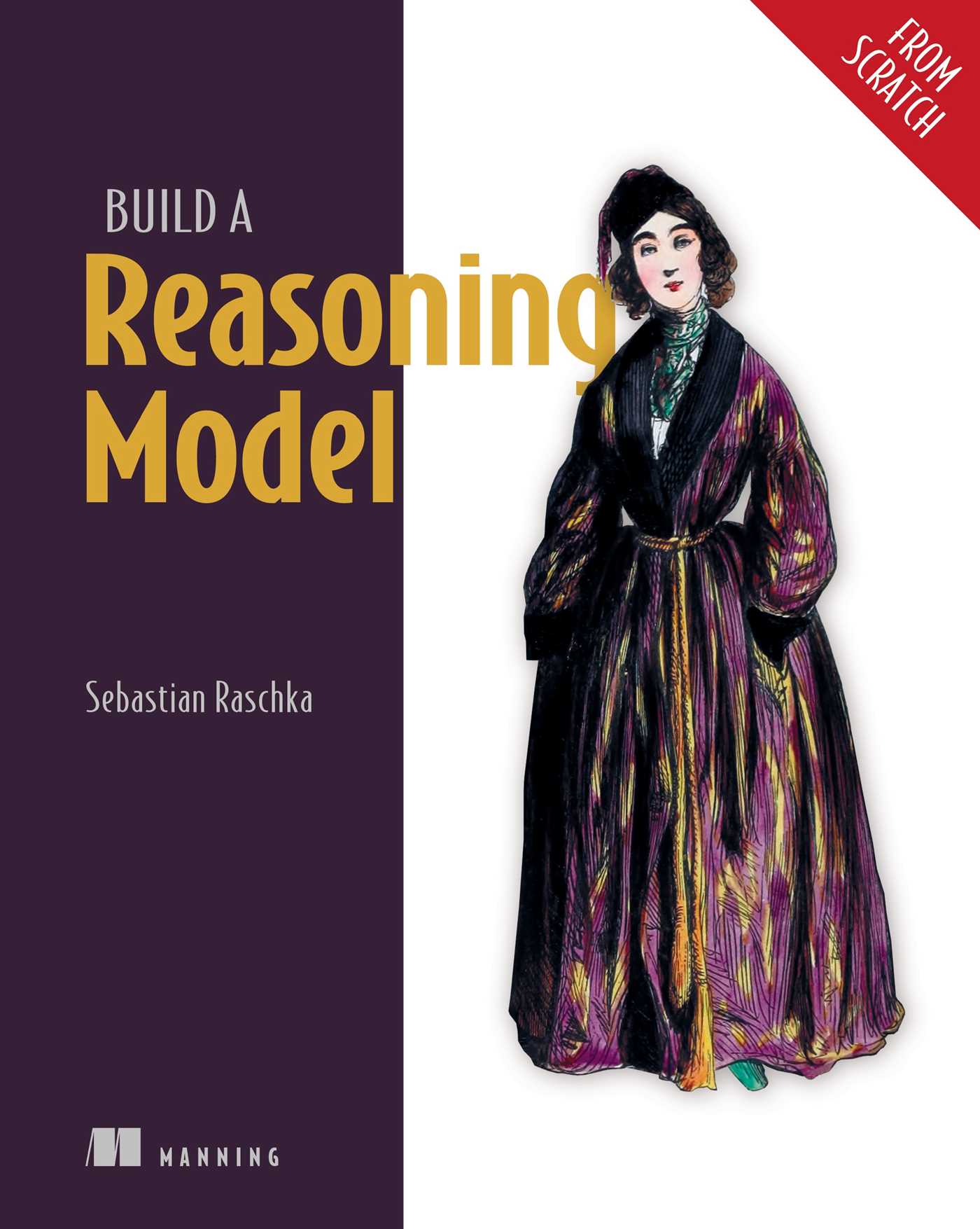
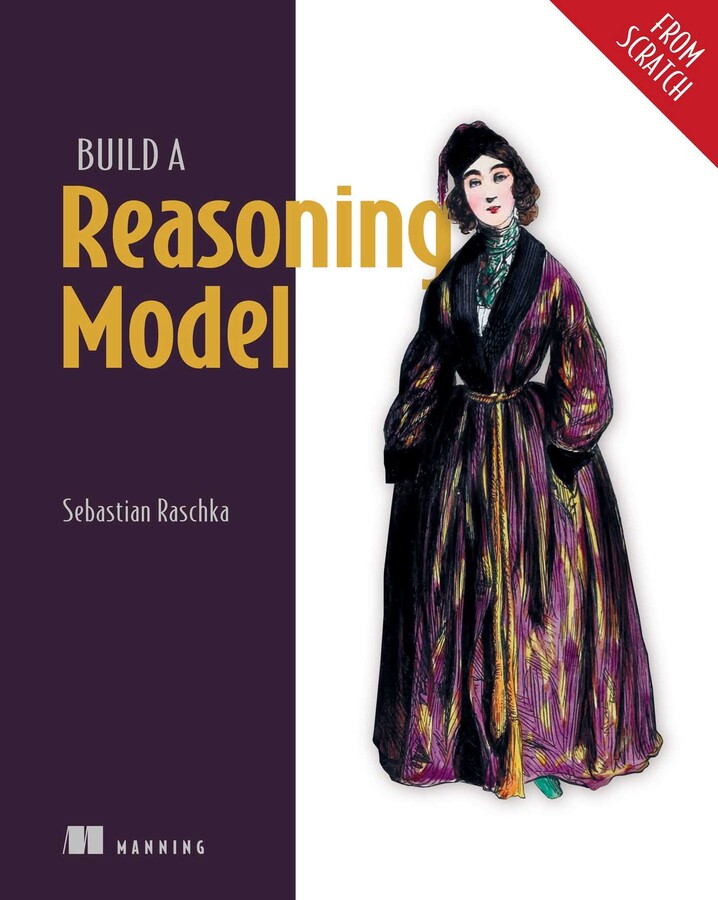
Book Cover Image (jpg): Build a Reasoning Model (From Scratch)
eBook 9781638358206